

Amazfit reveals the data behind Josh Kerr’s world record mile
Zepp Health has published the wearable data from Josh Kerr’s 3:42.66 world-record mile, including every 200-metre split, his cadence, heart rate and running power. The standout detail is not one huge peak, but how little his pace moved before he closed with the fastest lap of the race.
Kerr broke Hicham El Guerrouj’s 27-year-old record at the London Diamond League on July 18. His time was 0.47 seconds quicker than the 3:43.13 mark set in 1999, making him the first man to run a mile in under three minutes and 43 seconds.
The record was built on tiny margins
Kerr’s four laps came in 55.3, 55.8, 55.4 and 54.9 seconds. Every lap was under 56 seconds, only 0.9 seconds separated the slowest from the fastest, and the final circuit was the quickest of the lot.
The 200-metre splits were even tighter. They ranged from 27.4 to 27.9 seconds, so Kerr never drifted more than half a second away from his fastest segment across the entire race.
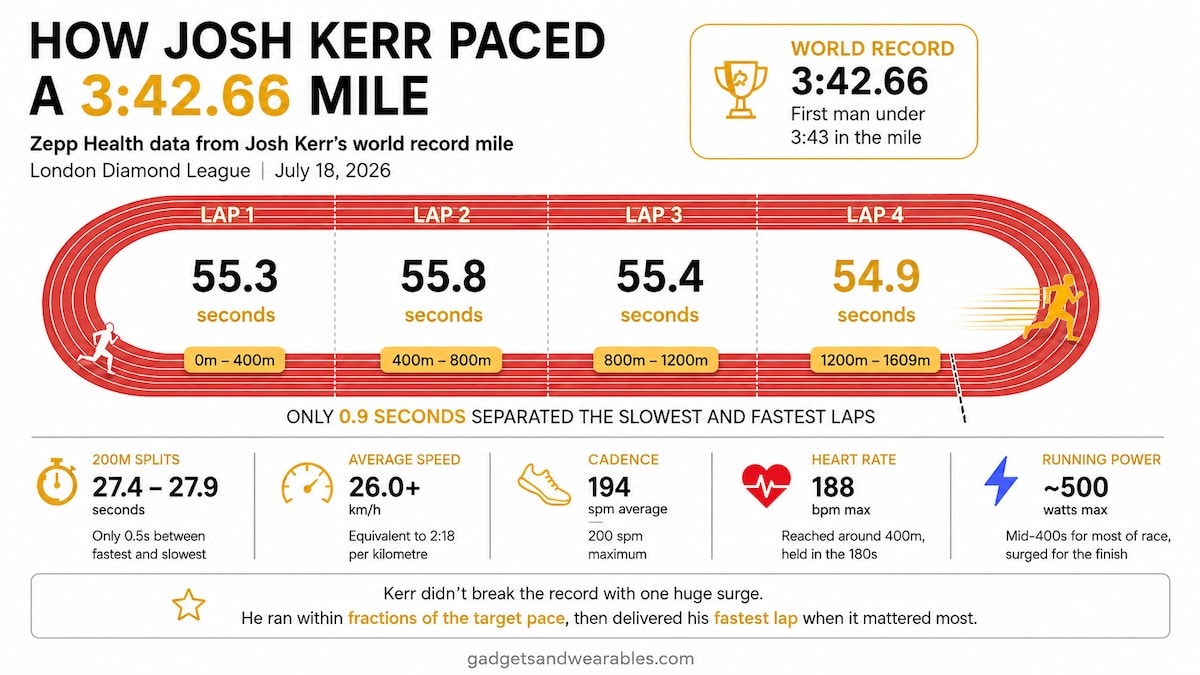
That consistency is the part of the data that really stands out. World records can look chaotic from trackside, particularly when pacemakers drop away and the athlete takes over, but Kerr’s numbers show very little panic. He stayed close to the required pace, then found enough for a slightly faster finish.
His average speed was just over 26 km/h. For comparison, a four-minute mile works out at around 24.1 km/h, so Kerr was moving almost 2 km/h faster than a barrier that still sounds absurdly quick to most runners.
Zepp Health says his cadence averaged 194 steps per minute and peaked at 200. Running power rose sharply at the start, settled in the mid-400-watt range, then increased again over the final 200 metres. The graph tells much the same story as the splits, with an aggressive opening, a controlled middle and a final lift.
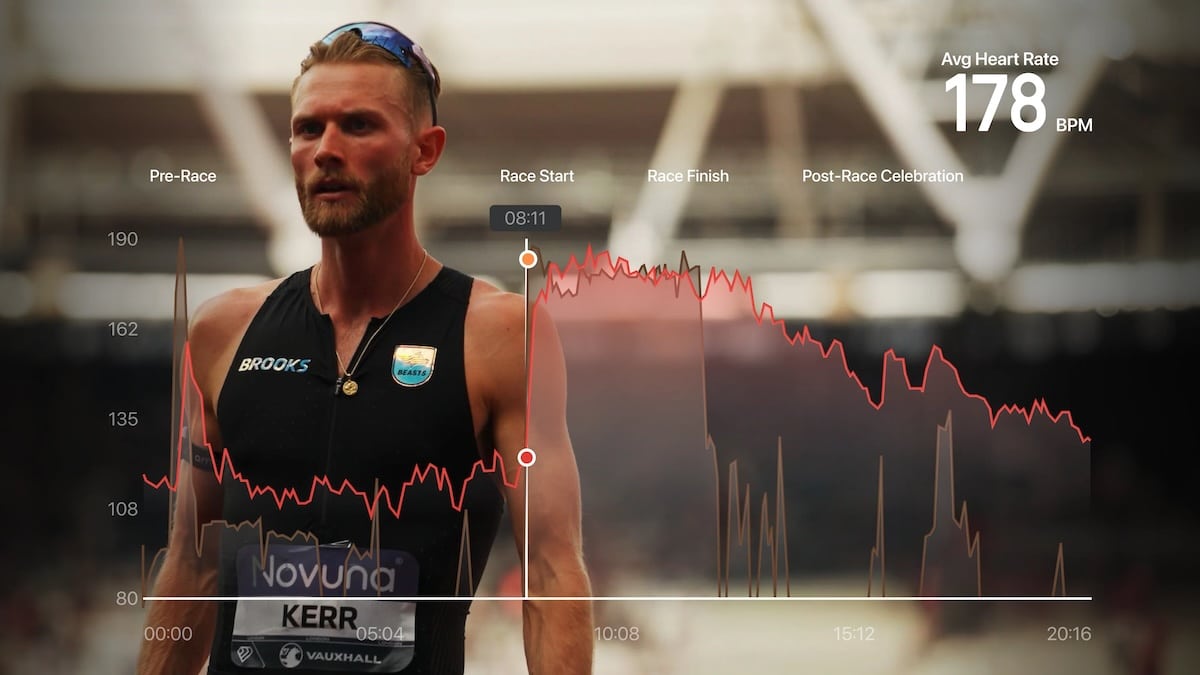
Heart rate climbed from 123 bpm on the start line to 160 bpm soon after the gun, reaching a maximum of 188 bpm around 400 metres into the race. It then remained in the 180s as Kerr held the pace through the middle laps. The average at the end came in at 178 bmp.
Why Zepp Health has Kerr’s data
You might be wondering, why Zepp Health has Kerr’s data.
The connection is not a random post-race tie-in. Kerr joined Amazfit as an elite athlete partner in February this year, with the Zepp Health-owned brand supplying wearables for his training, recovery and competition.
He has also been involved in the company’s performance testing work. Ahead of Project 222, Kerr used the Amazfit Cheetah 2 Pro and Helio Strap during training, while the Helio Ring tracked sleep and recovery as he prepared in an altitude-controlled bedroom.
That partnership explains why Zepp Health had access to detailed race data and why its devices were visible throughout the attempt. It also gives the company an obvious marketing win, although the published numbers are useful beyond the sponsorship story.
Kerr actually raced with a custom Cheetah 2 Pro featuring a 10-karat gold bezel, 84 lab-grown diamonds and “222” engraved on the clasp. The number referred to his target of running the mile in roughly 222 seconds, which he missed by only 0.66 seconds.
All in all, an impressive run. Kerr executed it perfectly from start to finish.
Source: Zepp Health
Don’t miss the latest from Gadgets & Wearables
Subscribe to our monthly newsletter and check out our YouTube channel.
You can also follow Gadgets & Wearables on Google News and add us as a preferred source in Google Search.

