

I tested four tennis ball machines and they are built for very different players
I have now spent serious court time with the Slinger Bag, Pongbot Pace S Pro, Acemate tennis robot S10 and Lumistar Tero, and choosing between them is not really about finding the one with the longest specification sheet. Each takes a different approach to solo tennis, from cheap and simple repetition to structured drills and a robot that actually reacts to the ball coming back.
That is what makes this comparison more interesting than simply ranking them from best to worst. Depending on how you practise, the least sophisticated machine here could easily be the right choice, while spending twice as much could get you technology you barely use.
The Lumistar Tero occupies what I think is the sweet spot for a lot of recreational players. It combines plenty of pace, adjustable spin, programmed and custom drills, app control and a very useful voice-control wristband, while still being exceptionally easy to transport and set up.
The Acemate tennis robot S10 takes a very different approach. Its cameras watch your return and the entire machine moves across the other side of the court, so the timing and position of the next ball can respond to what you have just done. Of these four, it comes closest to the feeling of having another player at the other end.
The Pongbot Pace S Pro is more focused on structured training. It combines high pace and spin with a huge drill library and player tracking, so it can use your position and recovery to shape the session. It feels aimed at players who want demanding, repeatable drills and a machine that can keep pushing the intensity.
The Slinger Bag is the most traditional option of the four. It fires balls, lets you adjust speed, frequency and elevation, and can add side-to-side movement with the optional oscillator. There is no app, player tracking or adaptive training logic, but that simplicity might be part of the appeal for some.
Tech specs compared
Specifications only tell part of the story here. Pongbot, Acemate and Tero all quote strong spin figures, for example, but they feel quite different on court because of how they deliver the ball, how drills work and whether the machine reacts to the player or the returned shot.
The biggest spec surprise is probably Tero. It is comfortably the lightest machine I have used here while still quoting the highest maximum ball speed, although its spin feels less aggressive in practice than the number suggests. Pongbot is the better choice if you specifically want heavier, faster and more demanding feeds, while Acemate’s selling point has little to do with winning the raw-spec contest.
Lumistar Tero
Tero is the machine I would probably point most recreational and intermediate players towards. It is exceptionally portable, takes about a minute to get running, and in my testing the feed has been consistent with no jams.
The wristband is a bigger deal than it sounds. Instead of walking back to the machine or constantly reaching for your phone, you can start and stop feeds or switch what you are working on with voice commands, and that keeps the session moving. There are 34 preset drills, custom sequences and 35 shot positions, so there is plenty to play with without the learning curve becoming excessive.
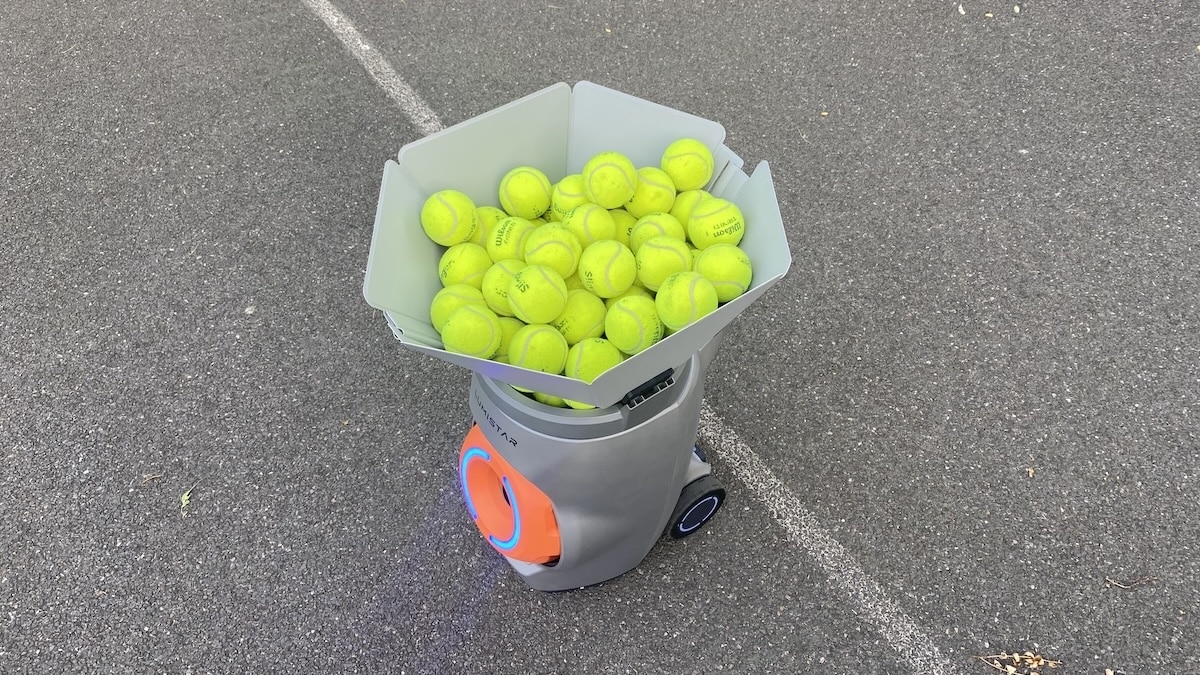
Tero does not watch the ball coming back at it. The wristband can provide position information, but there are no built-in cameras (unless you opt for the Pro version), so its training analysis is much less meaningful than what Acemate can produce. Spin is also the weakest part of its on-court performance, although pace is more than enough for the recreational and intermediate players I think this machine suits best.
Read my full Lumistar Tero review.
Acemate tennis robot S10
G&W01 for another $50 off.Acemate is best characterised as a tennis robot, and that is exactly why I like it. Rather than staying behind the baseline and waiting to fire the next programmed ball, the S10 uses two 4K cameras to follow your return, predicts where it is going and moves around the court on four omnidirectional wheels.
The timing is what makes the difference in practice. A slow return gives the machine more time before it sends the next ball, while a harder return brings the response sooner, so I found myself recovering and split-stepping much more naturally than I do against a fixed-interval machine. It still does not play exactly like another person, but of these four it comes comfortably closest.
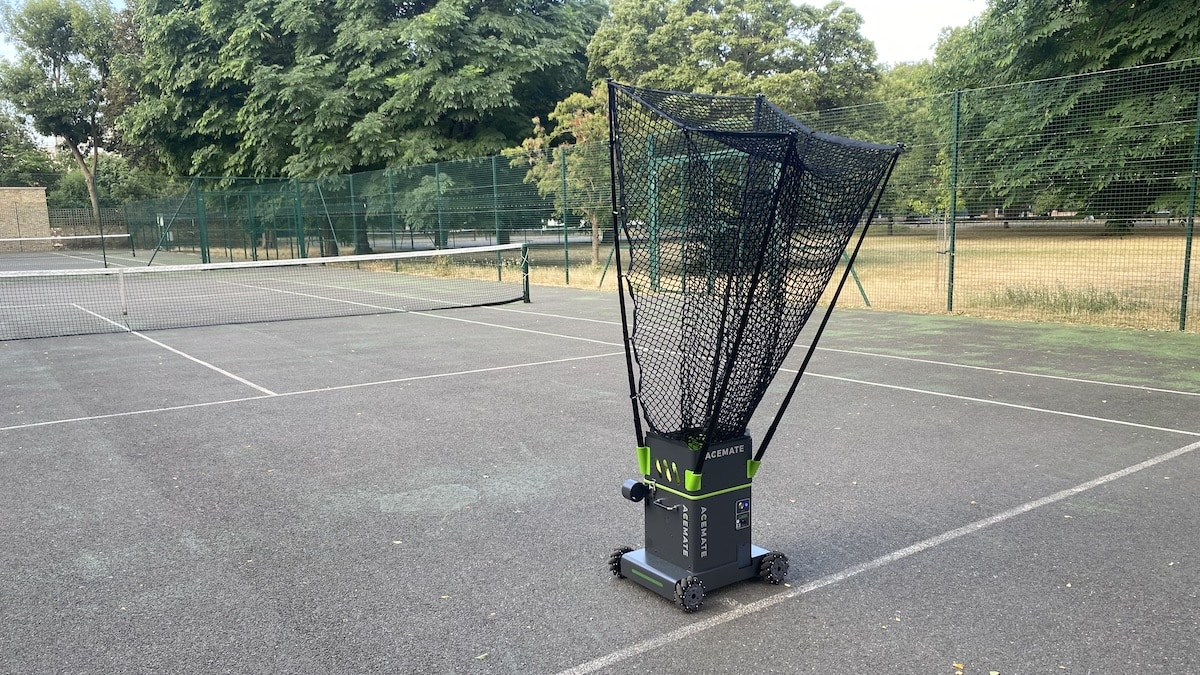
There are compromises. The 60 mph top speed is below Pongbot and Tero, the rated battery life is shorter, and the S10 is more awkward to pull any real distance than either Slinger or Tero. Strong tournament players looking mainly for brutal pace and spin may therefore prefer Pongbot, but recreational and intermediate players who get bored hitting predictable feeds may find Acemate much more engaging.
The optional catching net is clever as well. It catches a good number of balls coming its way and cuts down on how much time you spend collecting them. Plus you get useful analysis of your shots with detailed statistics, along with AI suggestions on how to improve your game.
One thing stands out here. Of these four machines, I found Acemate to be the most fun to use. The cameras, court movement and reactive timing make sessions feel less repetitive and much closer to actually rallying with someone.
Read my full Acemate tennis robot S10 review.
Pongbot Pace S Pro
gadgetsandwearables gives $75 off at checkout.Pongbot has its own advantages. It can fire balls at up to around 80 mph, generate strong topspin or backspin and hold more than 150 balls, while the battery is good for several long sessions rather than one afternoon on court.
What separates it from an ordinary high-powered launcher is the movement tracking. Sensors monitor your position at 100 Hz, allowing modes such as Recovery Trigger and Adaptive Rally to change the timing and pattern of feeds according to where you are and whether you have recovered into position. It is not watching the trajectory of your return in the same way Acemate does, but it is watching you, and that can make drills considerably more demanding.

The drill system is another strength. There are more than 500 presets, and custom drills let you change speed, spin, depth and placement ball by ball, so this is the machine I would take if my priority was structured repetition at a higher intensity. It is also the one of these four that gives stronger players the most room to turn the pace and spin up.
Read my full hands-on review of Pongbot Pace S Pro.
Slinger Bag
Slinger remains the easiest machine here to understand. You roll what looks like an oversized tennis bag onto court, set the speed and feed rate, adjust the elevation and start hitting. Add the oscillator and it can move the feed from side to side, which makes a major difference if you want to work on movement rather than stand in one spot.
Its biggest advantage is that it does two jobs at once. There is room for racquets, balls, drinks and other gear, so you do not necessarily need to bring a separate tennis bag, and the wheels make it easy enough to pull around despite the 15 kg weight. It is also the least intimidating option here if you just want hundreds of repeatable forehands and backhands without configuring an app first.
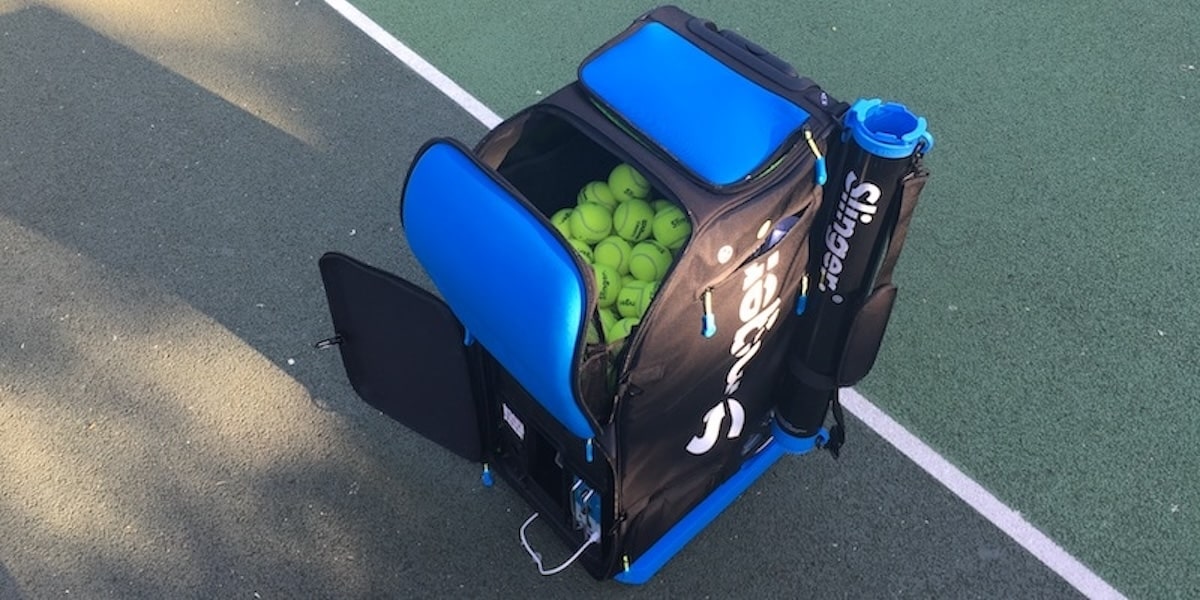
The limitations are equally obvious. Ball speed tops out at 45 mph, spin is not independently adjustable and drills depend heavily on where you position the machine and how you set the oscillator. After using the other three, Slinger feels basic, but basic is not automatically bad if that is all you actually need.
Read my full hands-on review of Slinger Bag.
There is no single winner because I would buy these machines for different reasons. Slinger is the sensible entry point if you want affordable repetition and do not care about apps or smart features, while Tero is the one I would choose for frequent no-fuss solo practice where portability is high on the list.
Pongbot makes more sense once training intensity becomes the priority. It has the pace, spin, ball capacity, battery life and drill system to keep stronger players busy, and its player tracking makes footwork a much bigger part of a session than with a normal stationary launcher.
Acemate takes the opposite approach. It gives up some outright pace and battery life in exchange for something none of the others really offers, a machine on the other side of the net that watches your shot, moves towards it and changes the timing of what comes back.
If I had to reduce the decision to four lines, I would put it this way. Buy Slinger for simplicity and price, Tero for portability and everyday usability, Pongbot for serious structured training, and Acemate if what you really want is a solo session that feels more like playing tennis.
Don’t miss the latest from Gadgets & Wearables
Subscribe to our monthly newsletter and check out our YouTube channel.
You can also follow Gadgets & Wearables on Google News and add us as a preferred source in Google Search.

