

Muse can now wake you during REM to help you remember dreams
Ever wake up from a completely bonkers dream, think there is no way you are going to forget it, then lose the whole thing about 30 seconds later? Muse is trying to fix exactly that.
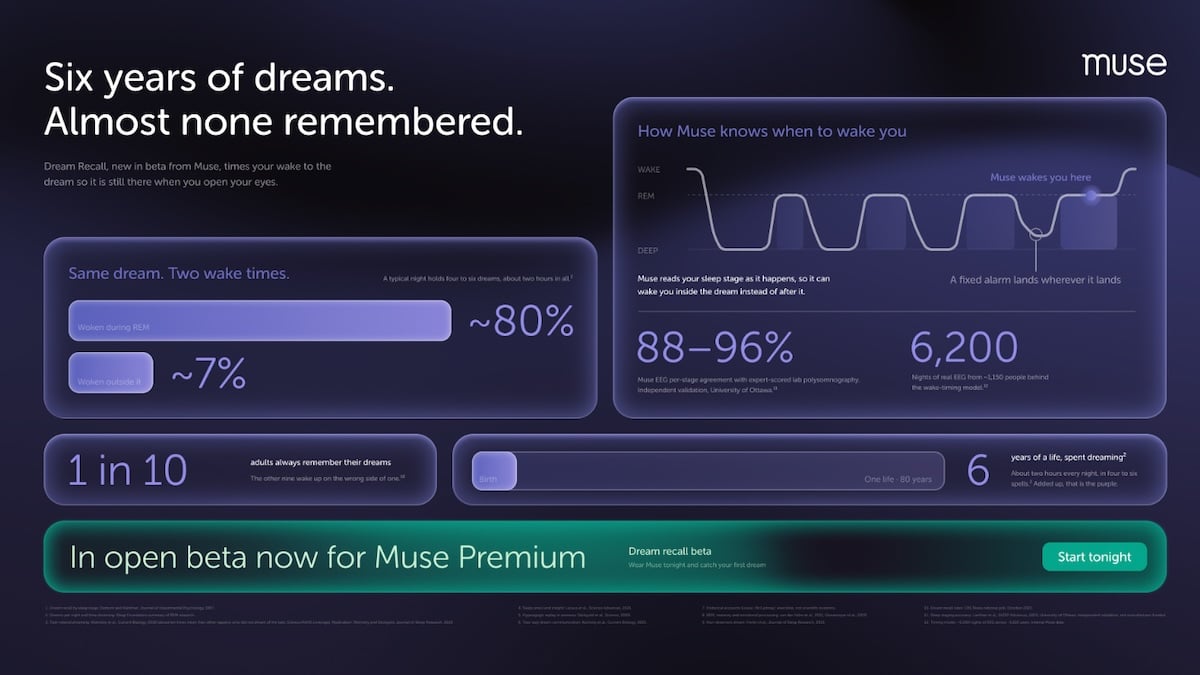
Its new Dream Recall feature uses real-time EEG data to work out when you are in REM sleep, then tries to wake you at the right moment while the dream is still fresh. The feature is now in beta as part of Smart Wakeup for Muse Premium subscribers using a Muse S or Muse S Athena.
The basic idea is pretty simple. Muse thinks remembering dreams has a lot to do with when you wake up, so instead of just sounding an alarm at a fixed time, the headband watches your brain activity overnight and looks for a better moment to pull you out of sleep.
It isn’t actually reading your dreams
It is worth being clear about what the headband is actually doing. Muse isn’t reading your dream, working out what you are dreaming about or recording anything happening inside your head.
Instead, its EEG sensors monitor brain activity and identify sleep stages in real time. When the system detects REM, Dream Recall can time the wake-up around that period rather than waiting until the dream has already started fading from memory.
Of course, dreaming and REM are not the same thing. Dreams can happen outside REM as well, but vivid dreaming is strongly associated with it, giving Muse a practical window to work with.
This is where EEG comes in
Muse has an advantage here over most smartwatches and smart rings. Those devices usually estimate sleep stages from signals such as movement and heart rate, while Muse measures electrical brain activity directly from the forehead.
That was one of the stronger parts of the Muse S Athena when I tested it. Its sleep tracking was particularly good at separating awake time from light sleep, an area where wrist-based trackers can sometimes struggle.
Muse has increasingly been using that EEG data while you are still asleep rather than simply handing you another chart the following morning. Deep Sleep Boost targets slow-wave sleep with timed audio, while Smart Wakeup looks for a lighter stage of sleep before sounding the alarm.
Dream Recall takes the same idea and points it at REM. There is also an Auto-Snooze function that reduces the sound as you begin to wake, with the idea of keeping you closer to that half-awake state where returning to the dream may be easier.
Muse is experimenting with sound cues too. Users can rehearse a cue while awake and then have it played during sleep, potentially making the sound recognisable inside a dream or helping with recall afterwards.
Wearables are starting to look at dreams
The idea of wearables moving into dreams isn’t unique to Muse. Earlier this year we uncovered an Oura patent describing dream detection and dream recall, including prompts and tools for recording what users remember after waking.
The big difference is that Muse has now moved beyond the design stage and put its version into a beta. Its EEG hardware also makes this a fairly natural extension of what the device is already measuring overnight.
Whether it actually leaves you remembering noticeably more dreams is the part that will need testing. Dream recall is subjective by nature, and waking people deliberately during REM also raises the obvious question of whether remembering more dreams is worth interrupting sleep for.
Those ready to dive in can pick up the Muse S Athena for $474.99 from the choosemuse.com website. To save 15%, use code “gadgetsandwearables” at check-out.
Don’t miss the latest from Gadgets & Wearables
Subscribe to our monthly newsletter and check out our YouTube channel.
You can also follow Gadgets & Wearables on Google News and add us as a preferred source in Google Search.

