

Samsung Galaxy Watch Ultra 2 vs Ultra: All the differences explained
Samsung Galaxy Watch Ultra 2 improves the original with a 35% larger battery, much faster charging, a slimmer body, a brighter display and Qualcomm’s new Snapdragon Wear Elite chip. It is clearly the better watch for a new buyer, but the case for upgrading from an existing Galaxy Watch Ultra is far less convincing.
The Galaxy Watch Ultra 2 is the one to buy when the two watches are reasonably close in price. Its 800mAh battery, fast charging, thinner case and brighter screen address several of the original Ultra’s weaker points without changing the basic design.
Existing Ultra owners should take a more cautious view. Unless battery life has deteriorated, the watch feels too bulky or diving support is useful, there is no pressing reason to replace it.
View on Samsung’s website*
Buyer | Best choice | Why |
|---|---|---|
Buying a new Galaxy Watch Ultra | Galaxy Watch Ultra 2 | Better battery, charging, display and processor |
Existing 2024 Ultra owner | Usually keep it | Most everyday functions remain similar |
Existing 2025 Ultra owner | Keep it | It already has the same 64GB storage as Ultra 2 |
Buying the original at a large discount | Galaxy Watch Ultra | Still offers the main smartwatch and fitness experience |
Recreational diver | Galaxy Watch Ultra 2 | Adds EN13319 certification and dedicated diving tools |
Small-wrist buyer | Neither is ideal | Ultra 2 is thinner, but its footprint remains very large |
Jump to
- Worth clarifying, there are actually two original Ultra models
- Galaxy Watch Ultra 2 vs. Ultra specifications
- It looks the same but should wear better
- Battery is the biggest reason to choose Ultra 2
- Snapdragon is the unknown quantity
- The display is larger and much brighter
- Health tracking is not a complete sensor overhaul
- Diving is the clearest new capability
- Trail running gets more attention
- Price could decide the comparison
- Which device to go for?
Worth clarifying, there are actually two original Ultra models
Samsung launched the first Galaxy Watch Ultra in 2024, then refreshed it in 2025. The second release added Titanium Blue and increased storage from 32GB to 64GB, but the processor, battery, display and sensor selection remained virtually unchanged.
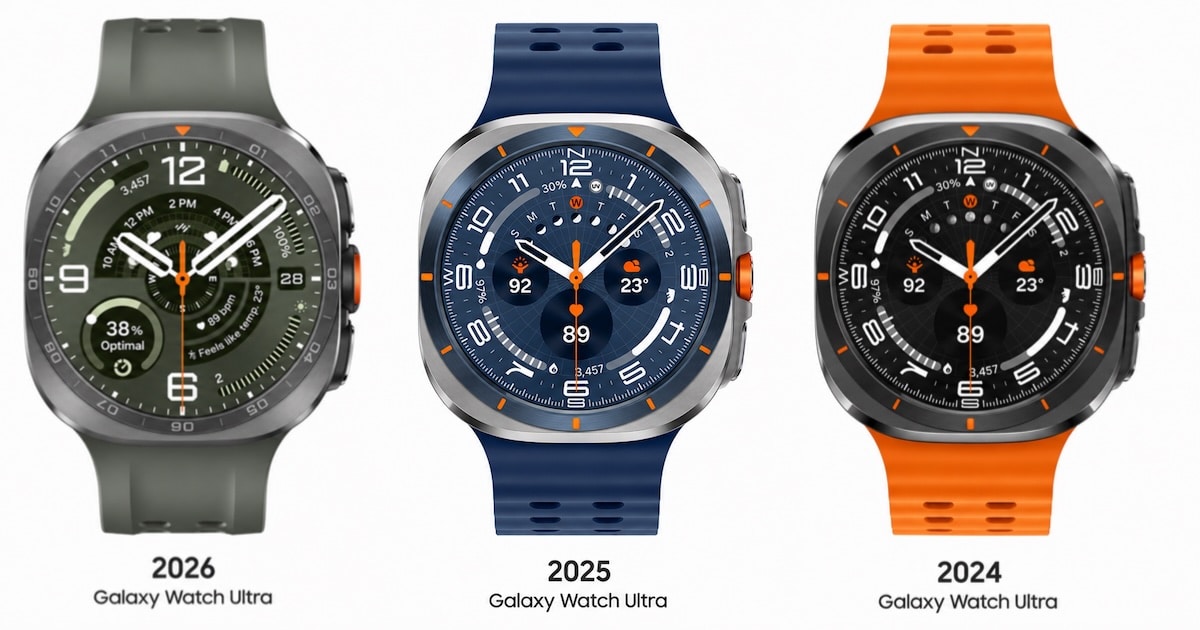
This distinction is important when comparing storage. Ultra 2 doubles the capacity of the 2024 model, but it offers no storage advantage over the 2025 Ultra, which already comes with 64GB.
For most of this comparison, the 2024 and 2025 versions can be treated as the same watch. Where storage and colour options differ, the model year needs to be taken into account.
With that in mind, let’s continue.
Galaxy Watch Ultra 2 vs Ultra specifications
The headline specifications point to a substantial hardware update, but not every difference will be equally noticeable in daily use. The larger battery, faster charging and slimmer case should have the clearest impact, while the new processor and brighter display are more likely to feel like useful refinements.
On mobile, swipe across the table to see both watches.
| Feature | Galaxy Watch Ultra 2 | Galaxy Watch Ultra |
|---|---|---|
| Product image |  |  |
| Case size | 47.4 × 47.1 × 10.7mm | 47.1 × 47.4 × 12.1mm |
| Weight without strap | 61.5g | 60.5g |
| Display | 1.52-inch AMOLED, 498 × 498 | 1.47-inch AMOLED, 480 × 480 |
| Peak brightness | 5,000 nits | 3,000 nits |
| Processor | Snapdragon Wear Elite | Exynos W1000 |
| RAM | 2GB | 2GB |
| Storage | 64GB | 32GB in 2024, 64GB in 2025 |
| Battery | 800mAh | 590mAh |
| Fast charging | Up to 40% in around 30 minutes | Not supported |
| GPS | Dual-frequency L1 and L5 | Dual-frequency L1 and L5 |
| Water protection | 10ATM and IP69K | 10ATM and IP68 |
| Diving certification | EN13319 | None |
| US launch price | $699 | $649 for the 2025 model |
It looks the same but should wear better
From the front, Galaxy Watch Ultra 2 could easily be mistaken for the original. Samsung has retained the 47mm cushion-shaped titanium case, circular display, three physical buttons and distinctive orange Quick Button.
The significant change appears when the watches are viewed from the side. Ultra 2 measures 10.7mm thick, down from 12.1mm, which works out to a reduction of around 12%.
That does not turn it into a small watch. The width and height have barely changed, so it will still dominate a smaller wrist and may feel excessive for sleep tracking.
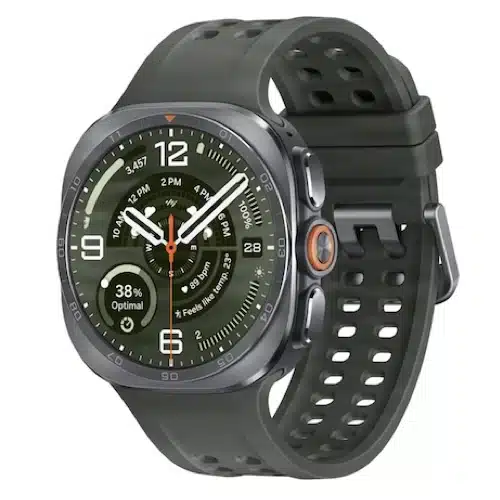
It should, however, sit closer to the skin and catch sleeves less often. The redesigned Marine Band is also softer and thinner, with an Air Pocket structure intended to help moisture escape.
One detail that has already been reported incorrectly is the weight. Ultra 2 weighs 61.5g without its strap, one gram more than the original, so the watch itself is not lighter.
Samsung’s lighter band may reduce the total weight on the wrist, but that is not the same as making the case lighter. Existing Ultra bands remain compatible, so owners do not need to replace their current collection.
Battery is the biggest reason to choose Ultra 2
Samsung has increased capacity from 590mAh to 800mAh, a jump of around 35.6%. That is easily the largest practical upgrade and the main reason some existing owners are considering replacing their watches.
The official runtime figures create a slightly odd situation. Samsung advertises up to 60 hours with the always-on display enabled and up to 80 hours with it switched off, even though the battery is substantially larger.
As we noted in our earlier look at Samsung’s Ultra 2 battery claims, the extra capacity does not automatically translate into a similar increase in advertised endurance. The brighter display, new processor, LTE modem, health processing and outdoor features may use some of that additional energy.
There should still be more breathing room during normal use. The larger cell should be particularly helpful during GPS workouts, LTE sessions and overnight tracking, where the original Ultra’s battery can feel more restrictive.
The difference may also feel larger for someone upgrading from a 2024 Ultra. A battery that has already gone through two years of regular charging will no longer perform like a new 590mAh cell, so the real comparison may be 800mAh against an ageing battery rather than the original factory specification.
Fast charging could have an equally noticeable effect. Ultra 2 can reach up to 40% in around 30 minutes, while Ultra has slower charging, with no equivalent 30-minute claim.
That makes it easier to top up the watch while showering, having breakfast or getting ready for bed. It also reduces the usual conflict between charging and collecting overnight sleep data.
Snapdragon Wear Elite is the unknown quantity
Ultra 2 moves from Samsung’s Exynos W1000 to Qualcomm’s Snapdragon Wear Elite. Both use a 3nm manufacturing process, but Qualcomm’s platform introduces a different CPU layout, on-device AI hardware and a redesigned low-power system.
Samsung says apps launch faster and interactions feel smoother. That sounds good, although the Exynos W1000 is already quick enough for normal watch use and early demonstrations do not show an enormous difference.
Efficiency could be more important than raw speed. LTE, GPS, background health tracking and the always-on display place a steady load on a smartwatch, so even modest power savings could improve endurance.
The new chip may also give Samsung more headroom for future health analysis and AI features. We previously looked at Samsung’s switch to Snapdragon Wear Elite, but the final judgement will depend on battery tests, heat, GPS performance and long-term software support.
The display is larger and much brighter
Samsung has reduced the bezel slightly, increasing the screen from 1.47 to 1.52 inches without making the case wider. Resolution moves from 480 x 480 to 498 x 498 pixels, so the difference in sharpness will probably be difficult to spot.
Brightness rises from 3,000 to 5,000 nits. That should improve visibility under strong sunlight and may be useful when glancing at workout data outdoors.
There is some small print behind the 5,000-nit figure, though. Samsung describes it as localised peak brightness under high ambient light, so the entire display will not necessarily sit at that level.
The original Ultra already has a bright screen, which means this is more refinement than rescue operation. It should be most noticeable on exposed trails, bright summer runs and underwater.
Health tracking is not a complete sensor overhaul
Samsung has packed broadly the same sensor categories on both watches, including its BioActive package, skin temperature, accelerometer, barometer, gyroscope, compass and ambient light sensor. Ultra 2 still supports ECG, body composition, blood oxygen, heart rate and the usual Samsung Health tools.
The company describes the BioActive sensor as upgraded on the Ultra 2 product page, but it does not provide much detail on what has changed internally. The closer fit due to the thinner case may contribute to better readings.
Many of Samsung’s newer health tools are software-led rather than dependent on new hardware. Vitals, Heart Health Score, Fitness Index and other features use signals that Galaxy Watches were already collecting.
Several of these tools were announced before Ultra 2 and are part of Samsung’s wider health platform. Our earlier coverage of the new Galaxy Watch health features explains how Vitals builds a personal baseline from overnight heart rate, HRV, breathing, temperature and blood oxygen.
Diving is the clearest new capability
Both watches carry a 10ATM rating, but Ultra 2 steps up from IP68 to IP69K and gains EN13319 certification. The IP69K rating adds protection against high-pressure and high-temperature water jets, while EN13319 covers depth and time instruments used for diving.
Ultra 2 can automatically show depth, dive duration and water temperature after entering the water. Samsung rates it for diving down to 40 metres, while more advanced software developed with Mares is scheduled to arrive later in 2026.
This is a real functional difference rather than a specification created for marketing. Anyone who plans to use a Galaxy Watch for recreational diving should choose Ultra 2.
For everyone else, IP69K is reassuring but unlikely to change daily use. The original Ultra is already rated to 10ATM, so Ultra 2 does not increase the headline pressure rating beyond 100 metres.
Trail running gets more attention
Ultra 2 introduces a dedicated Trail Run mode with elevation, climbing progress and terrain-related information. It also adds hydration guidance that estimates sweat loss relative to body weight and suggests when to drink.
This does not mean the watch directly measures hydration or sweat composition. It uses workout and personal data to estimate fluid loss, which can still be useful but should not be confused with a new hydration sensor.
Samsung also retains GPX navigation, dual-frequency GPS and climbing guidance. Those features make Ultra 2 a more credible outdoor watch, especially when combined with the larger battery.
It still approaches the category as a smartwatch first. Garmin and Coros offer deeper navigation, recovery and training systems, while Samsung remains stronger for apps, calls, messaging and integration with a Galaxy phone.
That same division appears repeatedly in owner discussions. People interested mainly in training continue to look towards Garmin, while those who want a watch that can replace more phone functions tend to favour Samsung.
Price could decide the comparison
Galaxy Watch Ultra 2 starts at $699 in the US, while the 2025 Ultra launched at $649. A $50 increase looks reasonable considering the upgrades.
The calculation changes once retailers discount the older model. If the price gap reaches several hundred dollars, the original Ultra begins to look much more attractive.
Existing owners are looking at the decision in much the same way. Many appear willing to upgrade only when trade-in offers bring the cost down substantially, while others see no point paying again for a watch that looks and behaves much like the one already on their wrist.
That is probably the right way to approach it. Ultra 2 is better hardware, but the value of those improvements depends heavily on what someone already owns and what the upgrade actually costs.
Which Galaxy Watch should you buy?
A new buyer should choose Galaxy Watch Ultra 2 when the difference is around $150 or less. The extra battery capacity, fast charging and slimmer fit are worth paying for over several years of ownership.
The original Ultra becomes the smarter purchase when it is heavily discounted. It still offers dual-frequency GPS, a bright sapphire display, LTE, Samsung Health, body composition and strong integration with Galaxy phones.
Owners of the 2024 Ultra have a slightly stronger upgrade case because they also move from 32GB to 64GB. Even then, battery condition and charging frustration are better reasons to upgrade than storage alone.
Owners of the 2025 Ultra can probably wait. They already have 64GB, the same basic sensor suite and almost the same design, so the purchase comes down mainly to battery, comfort, display brightness and diving.
Ultra 2 is Samsung’s best rugged smartwatch so far. It improves the original in several sensible ways, but it does not make the previous model obsolete.
For most existing owners, this is an upgrade to consider rather than one they need. For anyone buying their first Galaxy Watch Ultra, it is the version to get unless the original is available at a seriously lower price.
View on Samsung’s website*
Buyers who do not need the Ultra’s larger case and outdoor focus should also look at our Samsung Galaxy Watch9 vs Watch8 comparison. It covers the battery changes, Snapdragon Wear Elite processor and whether the standard Watch9 offers enough to justify upgrading from Watch8.
Don’t miss the latest from Gadgets & Wearables
Subscribe to our monthly newsletter and check out our YouTube channel.
You can also follow Gadgets & Wearables on Google News and add us as a preferred source in Google Search.


Great review! Balanced and honest.