

Google Pixel Watch 5 vs Samsung Galaxy Watch 9: Which should you buy
Pixel Watch 5 and Galaxy Watch 9 are pretty close on paper. Both run Wear OS 7, both have bright 3,000-nit AMOLED screens, both get dual-frequency GPS and both come in two sizes. The bigger differences are in what they focus on. Samsung packs in more health hardware and a tougher build, while Google leans more into GPS accuracy, safety features, smarter software and better battery life.
Let’s get into the detail.
Jump to
- Differences at a glance
- Google sticks with the dome while Samsung goes flatter
- Samsung has the faster chip but Google gives you more memory
- Battery life depends heavily on which size you buy
- GPS is no longer a reason to automatically pick Samsung
- Health tracking is where the philosophies really split
- Wear OS is shared but the ecosystems differ
- Which one should you buy?
Google Pixel Watch 5 vs Samsung Galaxy Watch 9 at a glance
These are arguably the two most obvious Wear OS choices for Android users in 2026. But they approach the job quite differently. Pixel Watch 5 is the cleaner Google-first option, while Galaxy Watch 9 packs in more sensors and gives Samsung Galaxy owners a deeper health ecosystem.
There are also a few differences that are easy to miss when looking only at the headline specifications. Google gives Pixel Watch 5 twice the storage of Galaxy Watch 9, Samsung uses sapphire crystal rather than Gorilla Glass, and the larger Pixel has a noticeable battery advantage on paper.
Google’s official specifications confirm the 64GB storage, dual-frequency GPS, Bluetooth 6.0 and 332mAh/465mAh batteries. Samsung lists 2GB of RAM, 32GB of storage, 390mAh/445mAh batteries and dual-frequency L1/L5 GPS for Galaxy Watch 9.
Our full wearable comparison tool goes deeper into the individual specifications. The more useful question here is how these differences affect the experience of actually owning the watches.
45 × 45 × 12.3mm
46.0 × 43.7 × 8.6mm
Full in around 45 / 60 minutes
Full in around 80 / 90 minutes
Google sticks with the dome while Samsung goes flatter
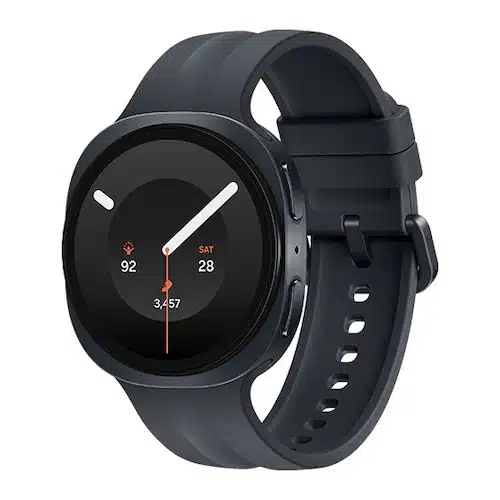
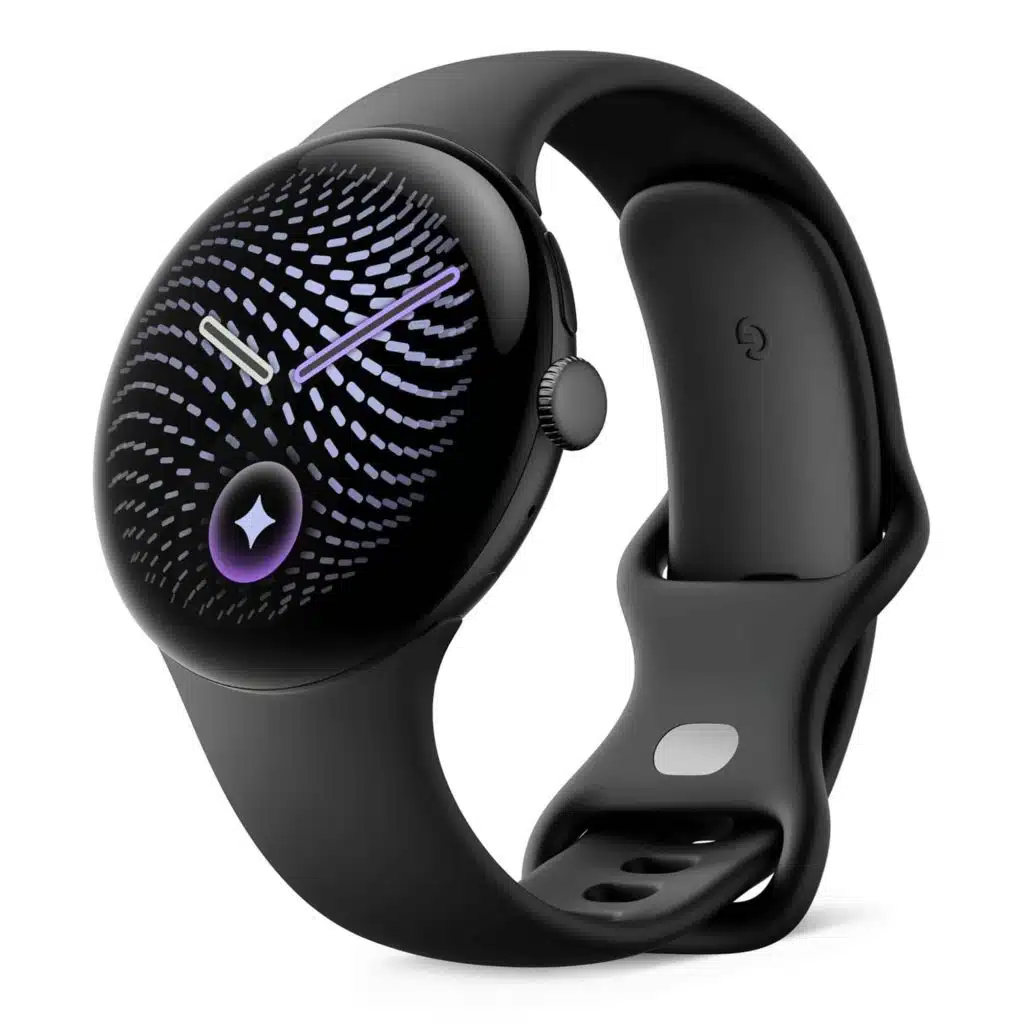
These watches could hardly look more different considering they run essentially the same underlying operating system. Pixel Watch 5 continues Google’s pebble-like design with a perfectly round aluminium case and curved glass flowing into its sides, while Samsung uses the cushion-shaped housing introduced with the previous Galaxy Watch generation.
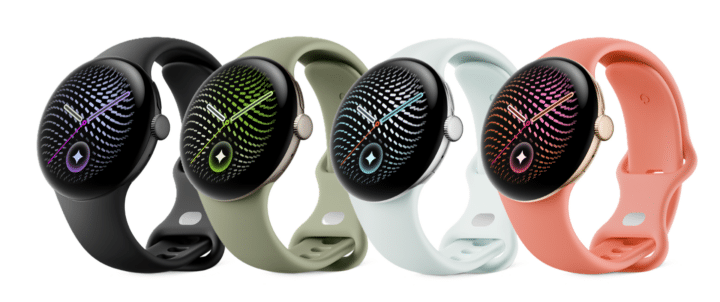
Samsung has a practical advantage here. Galaxy Watch 9 uses sapphire crystal and carries both IP68 and MIL-STD-810H ratings, while Pixel Watch 5 uses curved Gorilla Glass 5 with IP68 and 5 ATM water resistance. The curved Pixel glass is visually distinctive, but the Samsung is the one I would rather accidentally knock against a wall.
The official thickness figures also favour Samsung quite heavily, at 8.6mm compared with 12.3mm for either Pixel Watch 5. Manufacturer measurements are not always directly comparable because curved sensor housings can be treated differently, but Galaxy Watch 9 should still sit flatter on the wrist.
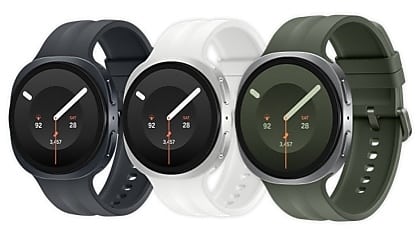
Weight is almost a draw at the smaller size. The 41mm Pixel weighs 31g compared with 31.5g for the 40mm Galaxy, while the 44mm Samsung comes in at 34g versus 36.7g for Google’s 45mm watch.
Displays are equally bright at up to 3,000 nits, so outdoor readability should not provide much reason to choose one over the other. Pixel Watch 5 does have an LTPO panel that can vary between 1Hz and 60Hz and drop to one nit with the always-on display, while Samsung counters with the more scratch-resistant sapphire covering.
Samsung has the faster chip but Google gives you more memory
One of the biggest Galaxy Watch 9 changes sits underneath the display. Samsung has switched to Qualcomm’s Snapdragon Wear Elite, a 3nm five-core platform, after several generations of relying on its own Exynos processors.
Google is using Qualcomm hardware too, but not the same chip. Pixel Watch 5 gets the Snapdragon W5 Gen 2 Accelerated alongside its Cortex-M55 coprocessor, with Google claiming a 12% CPU improvement and roughly 20% faster overall performance than Pixel Watch 4.
On raw processor hardware, Galaxy Watch 9 looks stronger. That does not automatically mean it will feel dramatically faster in normal use, though, and Google has made an interesting decision elsewhere.
Pixel Watch 5 has 3GB of RAM and 64GB of storage, compared with 2GB and 32GB on Galaxy Watch 9. We covered that memory jump in more detail in our Pixel Watch 5 vs Pixel Watch 4 comparison, and it may become increasingly useful as Wear OS pushes more AI processing and background tasks onto the watch itself.
So Samsung probably has the more powerful processor, while Google gives its watch more room to breathe. Over several years of software updates, that 3GB/64GB combination could prove every bit as useful as having the faster chipset.
Battery life depends heavily on which size you buy
Looking only at battery capacity gives a slightly misleading impression. The 40mm Galaxy Watch 9 has a substantially larger 390mAh battery than the 332mAh cell inside the 41mm Pixel Watch 5, yet both manufacturers quote up to 30 hours with the always-on display enabled.
Move to the larger watches and things change. Pixel Watch 5 has a 465mAh battery and Google quotes up to 40 hours with the always-on display active, while the 44mm Galaxy Watch 9 has a slightly smaller 445mAh battery and Samsung sticks with 30 hours.
Google also claims up to 72 hours in Battery Saver mode from the 45mm model, compared with Samsung’s broader claim of up to 40 hours when the always-on display is switched off. These estimates use different testing conditions, so I would not compare the Battery Saver numbers too literally, but the 45mm Pixel is clearly positioned as the longer-lasting watch.
Charging widens that difference. Pixel Watch 5 reaches around 50% in 15 minutes and takes roughly 45 minutes for a full charge on the 41mm model or 60 minutes on the 45mm version. Samsung quotes 80 minutes for the 40mm Galaxy Watch 9 and 90 minutes for the 44mm watch.
Neither watch turns Wear OS into a multi-day battery platform in normal use. But if I were choosing specifically for battery life, the 45mm Pixel Watch 5 is the more convincing option.
GPS is no longer a reason to automatically pick Samsung
Both watches now support dual-frequency positioning, so the basic GPS specification is effectively level. Samsung uses L1 and L5 GPS, while Pixel Watch 5 supports dual-frequency GPS across GPS, Galileo, GLONASS, BeiDou and QZSS.
Google is doing more than simply adding another frequency, however. Pixel Watch 5 uses technology derived from Google Maps to model how satellite signals travel through 3D buildings, while weather-station data helps compensate for atmospheric conditions. Google claims this makes route tracking twice as accurate as previous Pixel Watch generations in difficult environments.
The underlying approach is interesting. Google is increasingly treating GPS accuracy as a software and data-processing problem rather than simply a question of GNSS hardware.
Samsung has its own advantage on the training side. Fitness Index brings together VO2 max, BIA, heart rate, steps and activity data, Running Coach builds adaptive programmes lasting three to five weeks, and Daily Cardio Load looks at recent physical strain to help balance training and recovery.
Google has pushed further into strength training this year. Pixel Watch 5 can guide workouts, record weights and reps, manage rest periods and work with Google Health Coach to create customised strength sessions and recovery recommendations. Some of the more advanced Health Coach functionality requires a Google Health Premium subscription, which is worth factoring into the comparison.
Health tracking is where the philosophies really split
The core sensor lists overlap considerably. Both watches cover optical heart rate, ECG, SpO2, skin temperature and the usual motion sensors, but Samsung and Google then head in different directions.
Samsung has the broader measurement toolkit. Its BioActive sensor includes bioelectrical impedance analysis, allowing Galaxy Watch 9 to estimate body composition directly from the wrist. Samsung also offers Antioxidant Index, Energy Score, Vitals, Heart Health Score and its increasingly extensive sleep suite.
Galaxy Watch 9 can estimate morning blood pressure after calibration against a conventional cuff, and Samsung also offers FDA-cleared detection of signs associated with moderate to severe obstructive sleep apnea in supported markets. As usual with Samsung’s more advanced health features, availability varies by country and some functions depend on using Samsung Health Monitor and a compatible Galaxy phone.
Google does not offer body composition, but Pixel Watch 5 has a cEDA sensor for skin-conductance based body-response tracking. It also introduces Google’s Health Guardian layer, with monthly reports covering blood pressure trends, sleep breathing quality and insulin resistance trends.
Those Google features need careful wording. Pixel Watch 5 is not directly measuring blood pressure or glucose, and the insulin resistance feature is not continuous glucose monitoring. Google describes these as wellness trends rather than clinical readings, with the reports designed to identify changes over time after enough data has accumulated.
Pixel Watch 5 also has the stronger safety features. Google is building on Loss of Pulse Detection and satellite communication with breathing emergency detection, which can identify a severe and persistent fall in oxygen saturation combined with other sensor data and contact emergency services if the wearer becomes unresponsive. The feature is launching first in parts of Europe, so availability remains an important consideration.
Put simply, Galaxy Watch 9 is the more complete health measurement device. Pixel Watch 5 is increasingly about interpreting longer-term patterns and intervening when something appears seriously wrong.
Wear OS is shared but the ecosystems differ
Both watches run Wear OS 7 and both have Gemini, Google Maps, Gmail, Messages, Spotify and the wider Wear OS app catalogue. Samsung adds One UI 9 Watch on top, while Google keeps the interface much closer to its stock Wear OS vision.
That makes the old argument that Pixel Watch is the Google watch and Galaxy Watch is the Samsung watch slightly less useful than it once was. Galaxy Watch 9 still gives you Gemini and Google’s app ecosystem, while Pixel Watch 5 increasingly incorporates Fitbit and Google Health functionality into the same broader platform.
There are still ecosystem restrictions. Pixel Watch 5 works with most phones running Android 12 or newer, while Galaxy Watch 9 requires Android 13 or newer and at least 1.5GB of memory. Some of Samsung’s health functions work best, or only work, when paired with a Samsung Galaxy phone.
A Galaxy phone owner therefore gets the most complete Watch 9 experience. For someone using a Pixel, Motorola, OnePlus or another Android phone, Pixel Watch 5 is arguably the cleaner choice because you are less likely to run into Samsung-specific feature restrictions.
Galaxy Watch 9 probably wins on pure hardware value. It starts slightly cheaper, gives you sapphire crystal, MIL-STD-810H durability, body composition, a thinner case and Qualcomm’s newer Snapdragon Wear Elite platform. Samsung has also built an unusually broad health toolkit around the hardware.
Pixel Watch 5 makes the stronger case if you want Google’s health and safety direction rather than the longest possible list of sensors. Its enhanced GPS processing looks genuinely interesting, storage doubles to 64GB, RAM rises to 3GB, charging is faster and the 45mm model has the better official battery figures. The combination of cEDA, Health Guardian, Loss of Pulse Detection, breathing emergency detection and satellite communications also gives it capabilities Samsung does not directly match.
The phone in your pocket may ultimately settle it. Galaxy phone owners have a strong reason to choose Galaxy Watch 9 because Samsung’s health ecosystem works best when its devices stay together, while Pixel Watch 5 is the easier recommendation for someone who wants a Google-first Wear OS watch without those dependencies.
If I had to choose purely between the two watches rather than the ecosystems around them, Galaxy Watch 9 narrowly takes it on hardware and value. But the 45mm Pixel Watch 5 is arguably the more interesting device this year, particularly for battery life, GPS, safety and Google’s new approach to analysing health trends rather than simply adding another sensor.
Don’t miss the latest from Gadgets & Wearables
Subscribe to our monthly newsletter and check out our YouTube channel.
You can also follow Gadgets & Wearables on Google News and add us as a preferred source in Google Search.

