

Samsung explores a Galaxy Watch with a second screen
Ever glance at your watch, see something you want to deal with later and then forget all about it? Samsung has come up with a rather interesting solution involving a second display on the side of the watch.
The company has essentially filed a patent application for a wearable with two separate screens. One sits where you’d expect it to, on the front of the watch, while the other occupies part of the side of the case. And unlike a decorative strip of LEDs, this one would have a proper job to do.
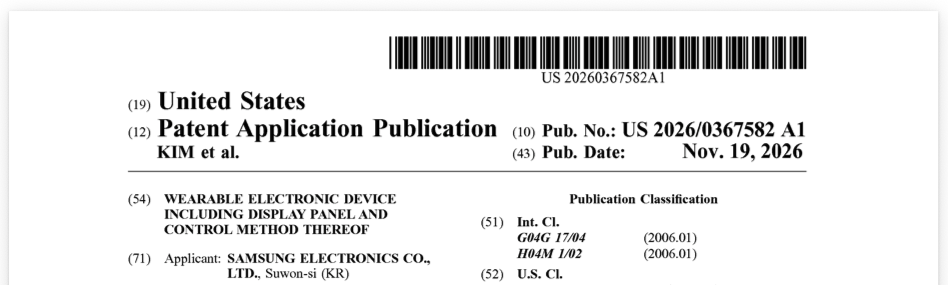
The US patent application (US 2026/0367582 A1) appeared on November 19. Samsung filed the US application in July, although its description traces the underlying design back to Korean filings in 2024. So this is something the company has been thinking about for a while.
Somewhere to put the stuff you aren’t using
There’s only so much you can do with a screen measuring an inch or so across. Open a message while tracking a workout, for example, and you’re no longer looking at your workout. You can switch back, of course, but the more things you’re juggling, the more fiddly it gets.
Samsung’s approach effectively gives the watch another place to put information. As described in the patent, a swipe towards the edge could move an open app out of the way and leave a small icon on the secondary display. You could then tap that icon to bring the app back to the main screen.

The side display could also show information associated with that app, such as an unread message count. Think of it as a tiny taskbar that lives on the outside of your watch rather than taking up precious space on the main screen.

There’s an interesting fitness angle here, too. One example described in the coverage of the filing involves showing running speed on the side display, with different colours indicating whether you’re above or below a target. That would leave the main screen free for other workout data, such as heart rate and distance.
Fitting another screen into a watch
The hardware is arguably just as interesting. Samsung describes an opening in the case frame, covered at least partially by the secondary display. A flexible connector passes through that opening to link the display to a circuit board inside the watch.
The design also incorporates separate sensors for gesture input on the two displays. In other words, Samsung isn’t just proposing a screen that mirrors the main one. It is looking at how the two panels can work together as part of a single interface.
Adding another screen introduces some fairly obvious trade-offs. You need to find room for the electronics, protect another exposed surface and manage the extra power consumption. There’s also the question of whether the display would be easy to see from a natural wrist angle.
Samsung’s Galaxy Watch 9 and Watch 8 already offer similarly sized AMOLED screens, as our comparison shows. Making the next watch face bigger isn’t necessarily going to improve usability if it also means making the case wider. Using some of the space around the edge is a different way of tackling that problem.
Don’t miss the latest from Gadgets & Wearables
Subscribe to our monthly newsletter and check out our YouTube channel.
You can also follow Gadgets & Wearables on Google News and add us as a preferred source in Google Search.

