

CIRQA vs Fitbit Air: Garmin wins on training, Google wins on value
Garmin launched CIRQA today, giving Fitbit Air a direct rival yet in the growing screen-less tracker category. Fitbit Air remains smaller, lighter and half the price, while CIRQA offers deeper training tools, longer battery life and tight integration with existing hardware.
Taking inspiration from Whoop, both devices collect health and activity data without putting another display on your wrist. Neither has built-in GPS, so outdoor routes depend on a connected phone, and both move most settings and data into their respective smartphone apps.
Those are the main similarities. What follows are the main differences.
Fitbit Air is smaller and lighter
Fitbit Air is the more discreet device. It weighs a mere 12 grams with its band, compared with 20 grams for CIRQA, and its narrower module should be easier to forget about during sleep and everyday wear.

That comfort was one of the strongest points in my Fitbit Air review. CIRQA is still compact compared with a Garmin watch, but its wider fabric band and larger module give it more of a Whoop-style appearance. In fact, it uses bands with 24mm width – larger than Whoop.
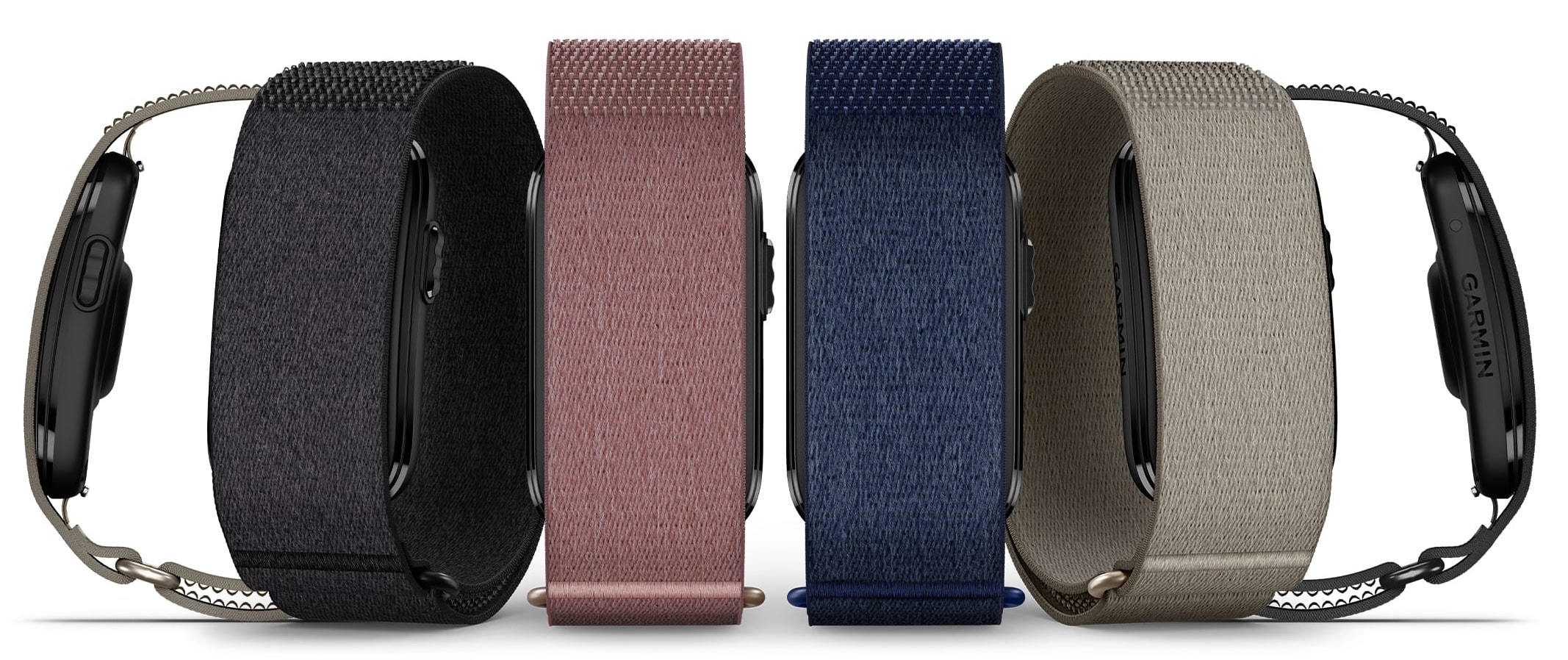
If you buy the Fitbit, it is a one-size-fits-all affair. With Garmin, you can choose between S/M and L/XL bands.
Both trackers can be worn away from the wrist. Garmin officially supports CIRQA on the upper arm and sells accessory bands for that, while I have also tested Fitbit Air on the wrist, ankle and upper arm, despite Google currently treating it as a wrist-based device.

CIRQA has a physical button
CIRQA’s physical button gives the band several controls that Fitbit Air lacks. One press starts or stops a favourite activity selected in Garmin Connect, with vibration and LED feedback confirming the action. Only one activity can be assigned to the button, while other profiles still need to be launched through the app.
The button can also activate Bluetooth pairing and start or stop heart-rate broadcasting to a compatible Garmin watch or Edge computer. When an alarm goes off, a short press snoozes it and holding the button dismisses it. It can also stop the vibration triggered through Find My Band.
Fitbit Air has no physical controls. It relies on automatic activity detection and the Google Health app, which gives it a cleaner design but makes it more dependent on the phone.
Fitbit Air has more sensors
Fitbit Air has the slightly broader documented sensor package. Alongside optical heart-rate and SpO2 sensors, it includes an accelerometer, gyroscope and device temperature sensor for tracking skin-temperature variation.

Fitbit Air also supports passive irregular rhythm notifications. CIRQA does not provide this. Nor does it include ECG, so neither device provides an on-demand ECG reading from the band.
What CIRQA covers is continuous heart rate, stress, respiration, skin temperature and Pulse Ox. Garmin gets more value from combining its core sensor data with established metrics such as Body Battery, HRV Status and Sleep Coach.
CIRQA integrates more deeply with existing training hardware
This is CIRQA’s biggest advantage. It can serve as the Primary Wearable for sleep, steps and daily health data, while a Garmin watch or Edge remains the Primary Training Device for workouts, GPS and training analysis.
CIRQA can also broadcast heart rate to compatible Garmin hardware. A cyclist could wear it on the upper arm and send live heart-rate data to an Edge computer, while a runner could use a Garmin watch for the workout and CIRQA for the rest of the day.
Fitbit Air works well as a passive second tracker, something I explored when wearing Fitbit Air alongside a Garmin. However, Google Health does not provide the same direct relationship between a passive band and dedicated training hardware.
CIRQA lasts longer between charges
Garmin quotes up to 10 days for CIRQA, compared with up to seven days for Fitbit Air. Both take around 90 minutes to charge fully, although Fitbit Air can recover roughly one day of battery life from a five-minute top-up.
The difference is useful, but not enormous. Features such connected GPS and prolonged heart-rate broadcasting will reduce CIRQA’s real-world result, while Fitbit Air already proved easy to keep charged during my testing.
Fitbit Air costs half as much
Neither device will break the bank. Fitbit Air starts at $99.99, while CIRQA costs $199.99. The extra $100 from buys CIRQA’s physical button, longer battery life, official upper-arm option and much deeper ecosystem integration. It does not buy a broader sensor package, a display or built-in GPS.
There is an optional subscription for the Fitbit, but you will be just fine without it. Most of the important stuff is free including core health, sleep and activity tracking.
Garmin also has an optional Connect+ subscription in the app which you do not really need. Most of the features work without this, except Workout and Training Plans, live activity, manual lap during activities and meditation. Which is great for those that want to use CIRQA as a second device to pair with their primary Garmin watch.
If you do opt for a subscription, Connect+ will set you back $69 per year, compared with $99 per year for Fitbit Premium. But, as mentioned, you don’t really need either.
CIRQA is the more logical choice for someone who already trains with a Garmin watch or Edge. It fills gaps in sleep and daily tracking without forcing the user to wear a full sports watch around the clock.
Fitbit Air is harder to beat on comfort and value. It is smaller, lighter and better equipped for passive health monitoring, while costing half as much.
For existing Garmin users, CIRQA’s ecosystem advantages may justify the higher price. For everyone else, Fitbit Air offers most of the screen-less tracking concept in a cheaper and more discreet package.
View CIRQA on Garmin’s website, view Fitbit Air on Amazon*

Specification | Garmin CIRQA | Fitbit Air |
|---|---|---|
Dimensions (core unit) | 27 × 47 × 9 mm | 34.9 × 17 × 8.3 mm |
Weight | 20.7g (S/M), 21.2g (L/XL) | 12g |
Controls | Physical button, vibration motor and multicolour LED | Vibration motor, LED |
Sensors | Accelerometer, optical heart-rate sensor (Gen 4), SpO2, temperature sensor | Accelerometer, gyroscope, optical heart-rate sensor, SpO2, temperature sensor |
GPS | Connected phone GPS | Connected phone GPS |
Memory | 128MB | Seven days of detailed motion data and 30 days of daily totals |
Battery life | Up to 10 days | Up to 7 days |
Charging | Up to 90 minutes; proprietary Garmin cable | Up to 90 minutes; one day from a five-minute charge |
Water resistance | 5 ATM | 5 ATM and IP68 |
Bands | 24mm woven straps in S/M and L/XL sizes | Textile or silicone bands for wrists measuring 130 to 210mm |
Connectivity | Bluetooth and heart-rate broadcasting | Bluetooth 5.0 and heart-rate broadcasting |
Colours | Black, sand, blue and red | Obsidian, Berry, Lavender, Fog and Stephen Curry edition |
Price | $199 | $99 |
Don’t miss the latest from Gadgets & Wearables
Subscribe to our monthly newsletter and check out our YouTube channel.
You can also follow Gadgets & Wearables on Google News and add us as a preferred source in Google Search.


Garmin has the body battery stat free of charge, whereas google needs a paid subscription for it, and this metric is very nice to have. So Garmin’s price is equivalent with that of a Fitbit Air plus one year of paid subscription, but you can use Garmin many years after that free of charge, so Fitbit is not a wise financial decision.
you only need a subscription for the ai health coach, the body battery equivalent is free