

Samsung Galaxy Watch9 vs Watch8: How they stack up
Samsung Galaxy Watch9 brings a larger battery, Qualcomm’s Snapdragon Wear Elite processor and a longer software-support period. It is the better watch for most new buyers, but the size you choose makes a surprisingly large difference to the value of the upgrade.
The 40mm Watch9 receives a substantial 20% battery-capacity increase over its Watch8 equivalent. The 44mm version gains just 10mAh, making it much harder to recommend to someone who already owns the previous model.
There is also the Galaxy Watch8 Classic to consider. It retains Samsung’s physical rotating bezel, offers twice the storage of the standard watches and has the same 445mAh battery as the larger Watch9, although it is considerably heavier and still uses Samsung’s older Exynos processor.
Galaxy Watch9 is the best choice for a new buyer when prices are reasonably close. The Snapdragon processor, larger 40mm battery and longer expected software support give it more room to age well.
Existing Watch8 owners can usually wait, particularly if they have the 44mm model. Galaxy Watch8 Classic remains the one to choose when the physical rotating bezel and stainless-steel construction matter more than weight, processor generation or long-term support.
View on Samsung’s website*
Buyer | Best choice | Why |
|---|---|---|
Buying a new 40mm Galaxy Watch | Galaxy Watch9 | Its 390mAh battery is 20% larger than the 40mm Watch8 battery |
Buying a new 44mm Galaxy Watch | Galaxy Watch9 at a similar price | The processor and support period matter more than the small battery increase |
Existing Watch8 owner | Usually keep it | The display, health sensors, design and everyday features remain very similar |
Buying at a large discount | Galaxy Watch8 | It retains the main Samsung Health, GPS and smartwatch experience |
Wanting a physical rotating bezel | Galaxy Watch8 Classic | It combines tactile controls with stainless steel and 64GB of storage |
Small-wrist buyer focused on battery | Galaxy Watch9 40mm | It provides the largest battery improvement without moving to a bulky case |
Planning to keep the watch for years | Galaxy Watch9 | It has the newer chip and the longest expected software-support period |
Jump to
- Galaxy Watch 9 vs 8 vs 8 Classic
- The battery upgrade depends on size
- Snapdragon Wear Elite is the bigger long-term change
- Watch 8 Classic remains a very different proposition
- The design has barely changed
- The displays are effectively identical
- Health tracking is mostly about interpretation
- GPS and fitness hardware have not moved far
- Watch8 bands still fit Watch9
- Price may matter more than the specifications
- Which device to go for?
Galaxy Watch 9 vs 8 vs 8 Classic specifications
Samsung has changed the processor and battery, but much of the surrounding hardware is familiar. The displays, dimensions, durability ratings, storage capacity and health sensor categories are effectively unchanged between Watch9 and the standard Watch8.
On mobile, swipe across the table to see both watches.


The battery upgrade depends on the size
Battery capacity is the most important difference, but the headline requires some qualification. Samsung has not improved the two Watch9 sizes by anything close to the same amount.
The 40mm Watch9 moves from 325mAh to 390mAh. That is an exact 20% increase and should provide more breathing room for sleep tracking, workouts and notifications on the smaller watch.
The 44mm version rises from 435mAh to 445mAh. That works out to an increase of only 2.3%, which is unlikely to transform how frequently it needs charging.

Most comparisons describe Watch9 as simply having a larger battery. Someone buying the 40mm model, however, benefits more. A 44mm buyer is getting almost the same battery as before.
Samsung still gives the watches a headline estimate of up to 30 hours with the always-on display enabled and 40 hours with it switched off. The larger battery therefore should not be interpreted as a guaranteed 20% improvement in actual runtime.
Early evidence is mixed. A ComputerBild test of the 40mm Watch9 produced a little over 24 hours, despite the larger battery, which was shorter than the publication recorded from its predecessor.
One result cannot describe every combination of settings, workouts and network use. It does show why capacity and endurance should not be treated as interchangeable figures, especially when the new Snapdragon platform may distribute power differently from Samsung’s Exynos chip.
Charging speed has not changed significantly either. Short top-ups remain useful, but Watch9 does not introduce the kind of charging improvement that would alter the daily routine on its own.
Snapdragon Wear Elite is the bigger long-term change
Watch9 replaces Samsung’s Exynos W1000 with Qualcomm’s Snapdragon Wear Elite platform. Both processors are manufactured using a 3nm process, but the Qualcomm chip introduces a different architecture and low-power system.
The Exynos W1000 already makes Watch8 feel responsive during ordinary use. Notifications, Samsung Health, maps and most apps do not suddenly become difficult simply because a newer processor exists.
Watch9 should still have advantages in app loading, voice processing and maintaining performance as Wear OS becomes more demanding. The new platform may also provide Samsung with more room for future on-device health analysis and Gemini features.
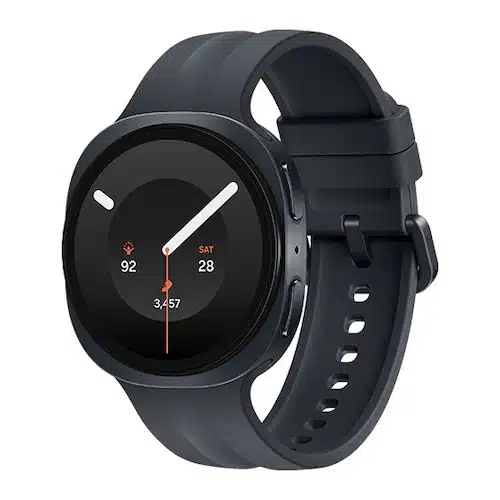
Battery efficiency is less certain. The Snapdragon name alone does not guarantee longer endurance, particularly when Samsung’s official runtime estimate has remained unchanged and the first independent results have not shown a clear breakthrough.
The stronger argument for the new chip is longevity. Samsung is promising five major Wear OS upgrades for Watch9, with security support expected to continue into 2031, giving it a longer runway than the Watch8 generation.
For someone who replaces a watch every two or three years, that difference may have little practical value. Anyone planning to keep it for four or five years has a better reason to pay extra for Watch9.
Watch8 Classic remains a very different proposition
Galaxy Watch8 Classic is not simply a larger Watch8. Its stainless-steel case, physical rotating bezel, additional Quick Button and 64GB of storage give it a distinct identity.
The rotating bezel remains one of Samsung’s best watch controls. It makes scrolling through menus and notifications easy without covering the screen with a finger, and it gives the Classic a more conventional watch-like feel.
There are substantial compromises. The Classic weighs 63.5g before the strap is attached, compared with 34g for the 44mm Watch9, and its 10.6mm case is noticeably thicker than the 8.6mm standard models.
It also uses a 1.34-inch display, the same screen size as the 40mm watches, despite having a 46mm case. The physical bezel occupies space that Samsung uses for additional display area on the 44mm Watch9 and Watch8.
Battery capacity is more competitive. Watch8 Classic has a 445mAh cell, matching the larger Watch9 and slightly exceeding the 44mm Watch8.
Storage doubles from 32GB to 64GB, which is helpful for offline music, apps and downloaded media. It retains the Exynos W1000, however, so buyers do not receive Watch9’s new processor or extended support period.
At its $499.99 starting price, the Classic is difficult to recommend purely on specifications. It makes the most sense when the rotating bezel and stainless-steel construction are features someone actively wants, rather than extras that merely sound useful.
The design has barely changed
Samsung has retained the cushion-shaped case introduced with Watch8. The circular display sits inside a softly squared outer frame, producing a design that falls somewhere between a conventional Galaxy Watch and the larger Ultra.
Watch9 uses the same 40mm and 44mm sizes and the same 8.6mm thickness. The case is slightly heavier, rising from 30g to 31.5g at 40mm and from 33.8g to 34g at 44mm.
Those increases are too small to affect comfort. Both standard watches remain much easier to wear overnight than Watch8 Classic or either Galaxy Watch Ultra generation.
The design continues to divide opinion. Some will find the cushion shape more distinctive than Samsung’s older fully circular cases, while others will see little reason to replace a Watch8 with something that looks almost identical.
Watch9 does introduce Cream as a 40mm color, while the larger version is available in Graphite and Silver. Color availability is a minor buying consideration rather than an upgrade reason.
The displays are effectively identical
Watch9 retains the same display sizes, resolutions and claimed 3,000-nit peak brightness as Watch8. The 40mm models use a 1.34-inch, 438 x 438 panel, while the 44mm versions use a 1.47-inch, 480 x 480 panel.
Both generations use Super AMOLED panels protected by sapphire crystal. Visibility, sharpness and always-on watch faces should therefore look very similar.
The Classic also reaches 3,000 nits, but its physical bezel limits it to the smaller 1.34-inch display. Buyers are trading screen area for tactile control rather than gaining both.
The unchanged displays reinforce the broader upgrade picture. Watch9 improves the platform underneath the screen, but it does not provide a visibly larger, brighter or sharper interface.
Health tracking is mostly about interpretation
Samsung lists the same core sensor categories across all three watches. These include optical heart-rate monitoring, ECG, bioelectrical impedance analysis, blood oxygen, temperature, accelerometer, gyroscope, barometer, compass and ambient light sensing.
Watch9 launches with additional tools including Vitals, Heart Health Score and Fitness Index. These features organize and interpret signals the watch is already collecting rather than measuring an entirely new type of health data.
Vitals builds a baseline using overnight measurements and looks for changes from someone’s usual patterns. Heart Health Score and Fitness Index apply further analysis to existing cardiovascular and activity information.
That may make the presentation more useful, but it is not a completely new health-sensing platform. Some of these software features are also expected to reach older watches through Samsung Health updates, although availability and timing may differ by device and region.
Watch8 already provides Running Coach, Energy Score, sleep coaching, Bedtime Guidance, Antioxidant Index and Vascular Load in supported markets. The everyday health experience is therefore much closer than Samsung’s Watch9 feature list initially suggests.
The usual restrictions remain. Some health functions require a compatible Samsung Galaxy phone, and ECG, blood-pressure and sleep-apnea features depend on local regulatory approval.
GPS and fitness hardware have not moved far
All three models support dual-frequency L1 and L5 GPS. This was already one of Watch8’s more valuable improvements, particularly when tracking through built-up areas or beneath heavy tree cover.
Watch9 does not introduce a clearly different GPS system in Samsung’s specifications. Any change in route accuracy or power consumption would therefore be more likely to come from software, antenna tuning or the Snapdragon platform than a new headline capability.
The same applies to workout tracking. Samsung Health remains well suited to general fitness, running plans, sleep tracking and daily activity, but Watch9 does not suddenly turn the standard Galaxy Watch into a specialist endurance device.
The more revealing buying debate continues to be Samsung against Garmin rather than Watch9 against Watch8. Samsung is stronger for apps, calls, messaging and everyday phone integration, while specialist sports watches generally provide longer endurance and deeper training analysis.
Watch8 bands still fit Watch9
Samsung has retained the Dynamic Lug System used by the Watch8 generation. Compatible Watch8 and Watch8 Classic bands can therefore be used with Watch9, and Samsung is selling newer bands as compatible across the three models.
That removes a potential hidden upgrade cost for existing owners. Someone who has already bought several Watch8 bands does not need to replace the collection when moving to Watch9.
Galaxy Watch Ultra bands use a different connection and are not interchangeable. The compatibility applies to the standard Watch8, Watch8 Classic and Watch9 Dynamic Lug families.
Price may matter more than the specifications
Galaxy Watch9 starts at $379.99 for the 40mm Bluetooth model and $409.99 at 44mm. Adding LTE increases either price by $50.
Watch8 launched at $349.99 and $379.99, making Watch9 officially $30 more expensive at each size. That is a reasonable premium for the Snapdragon processor, larger 40mm battery and longer support period.
Retail discounts create a different comparison. Samsung has already listed Watch8 from around $299.99, and third-party prices may fall further as retailers clear older stock.
At 40mm, paying around $50 to $80 more for Watch9 is defensible because the battery increase is substantial. Once the difference passes roughly $100, Watch8 becomes the stronger value unless long-term software support is especially important.
At 44mm, the older watch becomes attractive sooner. Watch9 adds just 10mAh, so the processor and support period must do most of the work when justifying the extra cost.
Watch8 Classic starts at $499.99, or $549.99 with LTE. At that price, it should be chosen for its bezel, steel construction and 64GB storage rather than on the assumption that “Classic” means universally better.
Trade-in offers can, of course, overturn any of these calculations. So they are worth checking out.
Which Galaxy Watch should you buy?
Galaxy Watch9 is the most sensible choice for someone buying a new standard Galaxy Watch at close to the launch price. Its Snapdragon processor and longer software support should matter over several years, while the 40mm version receives a genuinely useful battery increase.
The 44mm comparison is less decisive because capacity moves from 435mAh to only 445mAh. Watch9 remains the better long-term purchase at a small price difference, but a discounted 44mm Watch8 delivers most of the same experience.
Existing Watch8 owners can usually keep what they have. The design, displays, sensors, GPS, storage and core Samsung Health experience remain too similar to make this an essential annual upgrade.
Galaxy Watch8 Classic is the specialist choice within the group. Its rotating bezel, stainless-steel case, Quick Button and 64GB storage make it more distinctive, although its weight, smaller display area and older processor stop it from being the automatic premium winner.
The biggest mistake would be treating Watch9 as an identical upgrade at both sizes. It is a much more convincing improvement at 40mm, while the 44mm model is mainly a processor and software-support update.
View on Samsung’s website*
Samsung’s standard watches are not the only models to receive a major update this year. Our full Galaxy Watch Ultra 2 vs Ultra comparison looks at the larger battery, faster charging, slimmer case and new Snapdragon processor, as well as whether the changes justify upgrading from the original Ultra.
Don’t miss the latest from Gadgets & Wearables
Subscribe to our monthly newsletter and check out our YouTube channel.
You can also follow Gadgets & Wearables on Google News and add us as a preferred source in Google Search.

