

Garmin CIRQA Smart Ring appears in Indonesian certification database
The Indonesian regulatory site has now removed the filing. If this had simply been a spelling error, you would expect the listing to be corrected rather than disappear altogether.
A new Garmin filing in Indonesia has thrown up something unexpected. The model name is listed as “CIRQA SMART RING,” suggesting Garmin may be looking at taking CIRQA off the wrist and onto the finger.
Garmin only launched the CIRQA Smart Band a few weeks ago, so seeing the same name attached to a smart ring is unexpected. It could still turn out to be an administrative mistake. But there is enough here that it should not be dismissed as one without further evidence.
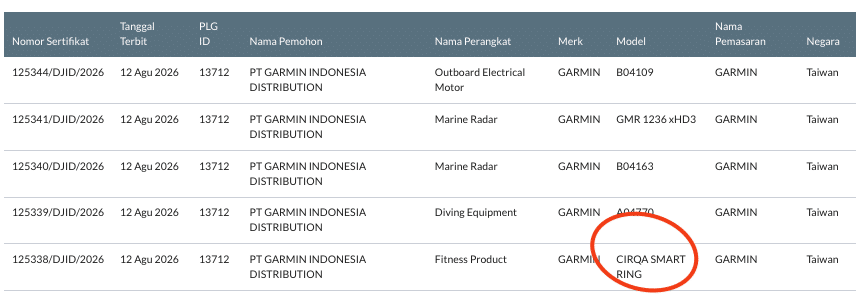
The certification actually says CIRQA Smart Ring
The entry comes from Indonesia’s telecommunications certification database and was issued to PT Garmin Indonesia Distribution on August 12, 2026. It lists the device category as “Fitness Product,” the brand as GARMIN and, most importantly, the model as “CIRQA SMART RING.”
The marketing-name field separately says GARMIN, while Taiwan is listed as the country of origin. The certificate number is 125338/DJID/2026. And the entry appears alongside several other Garmin products certified on the same day, including marine and diving hardware.
That distinction between the fields is worth paying attention to. “CIRQA SMART RING” is not being generated from the generic product category, and it is not merely appearing somewhere in a descriptive note. It sits directly in the model column.
Garmin has not announced a CIRQA Smart Ring, and its Indonesian website currently promotes the existing CIRQA Smart Band. Garmin’s own July announcement also describes CIRQA specifically as its first screen-free smart band, with wrist and upper-arm wearing options.
So there is a clear mismatch between Garmin’s public product range and this new regulatory entry.
A typo is possible, but the wording is oddly specific
Regulatory databases are not immune to mistakes. Product names can be entered incorrectly, fields occasionally contain marketing terminology rather than hardware identifiers. Plus, information supplied during certification does not always match the final retail naming.
That remains the main reason for caution here. It is entirely possible that someone intended to enter CIRQA Smart Band and somehow ended up with CIRQA Smart Ring instead.
Still, that would be a rather specific error. “Smart Ring” is not a minor spelling difference or slightly different translation of “Smart Band.” It describes an entirely different wearable form factor, and Garmin already has an established CIRQA Smart Band name that would have been straightforward to enter.
There is also some logic to Garmin expanding CIRQA rather than creating another completely separate brand. Before the Smart Band launched, Garmin’s CIRQA trademark filing used broad language covering body-worn electronic sensors and physiological monitoring rather than limiting CIRQA to something worn around the wrist.
At the time, that language made sense for what eventually became the Smart Band. In hindsight, it would also give Garmin plenty of room to use CIRQA as a wider family of low-profile health and fitness wearables.
A Garmin smart ring would fit surprisingly well
A Garmin ring would not need a new software platform. Most of the difficult part already exists inside Garmin Connect. This includes sleep tracking, HRV Status, Body Battery, stress, skin temperature and recovery-related metrics.
The recently launched CIRQA band shows the company is also willing to separate those capabilities from the traditional smartwatch format. It tracks health continuously without a screen, sends the data into Garmin Connect and provides many of Garmin’s familiar training and recovery features.
Moving some of that experience onto a finger would make sense. It would put Garmin into a category currently occupied by Oura, RingConn, Samsung, Ultrahuman and others. Our best smart rings comparison shows just how broad that market has become. Most of these devices lean heavily towards sleep, recovery and passive health tracking rather than serious workout recording.
That could actually suit Garmin rather well. A ring could collect overnight and everyday health data while a Forerunner, Fenix or Edge handles workouts, GPS and live training information. Garmin has already adopted a similar two-device idea with CIRQA, which can work alongside the company’s watches and cycling computers.
There would be plenty of technical questions, though. Optical heart-rate performance during exercise remains difficult for smart rings, battery capacity is much more constrained, and Garmin would need to decide how much of CIRQA’s training functionality makes sense on such a small device.
More regulatory appearances would quickly clear that up. A Bluetooth qualification, FCC filing, additional Asian certification or reference somewhere inside Garmin’s own software could establish whether there really is separate ring hardware moving towards release.
Until then, the interesting part is the wording itself. Garmin has just entered the screenless tracker market with CIRQA, and less than a month later the CIRQA Smart Ring name has appeared in an official certification database. That is not confirmation of Garmin’s first smart ring, but it is certainly enough reason to start looking for one.
Source: e-Sertifikasi (via GarminNews)
Don’t miss the latest from Gadgets & Wearables
Subscribe to our monthly newsletter and check out our YouTube channel.
You can also follow Gadgets & Wearables on Google News and add us as a preferred source in Google Search.

