

KardiaMobile 6L vs KardiaMobile vs Card: Which one should you buy?
Table of Contents
AliveCor has three KardiaMobile devices that look like variations on the same idea, but the differences become much clearer once you actually use them. KardiaMobile is the value option, KardiaMobile Card is built around portability, while KardiaMobile 6L is the one that gives you considerably more ECG data.
All of these devices let you take an ECG with your phone, all use the same Kardia app, and all take around 30 seconds for a basic recording. But they are not interchangeable.
I have spent time testing both the KardiaMobile 6L and KardiaMobile Card, and the choice between them is easy once you decide what matters most. The standard KardiaMobile sits between those two in concept, although closer to the Card in terms of what it actually records.
Here is how the three stack up.
KardiaMobile | KardiaMobile Card | KardiaMobile 6L | |
|---|---|---|---|
ECG | Single lead | Single lead | Single lead or six lead |
Leads | Lead I | Lead I | I, II, III, aVR, aVL, aVF |
Weight | 18g | 7.4g | 24g |
Size | 82 x 32 x 3.5mm | 85.6 x 54 x 1.2mm | 90 x 30 x 7.2mm |
Connection | Ultrasonic audio | Bluetooth | Bluetooth |
Battery | Replaceable CR2016 | Built-in, non-replaceable | Replaceable CR2016 |
Typical battery life | Around 1 year or more | Around 2 years | Around 1 year |
Main advantage | Price and simplicity | Wallet-sized design | Six-lead ECG |
Best for | Basic ECG checks | Carrying everywhere | More detailed ECG recordings |
The design is not the only real difference
All three devices do the same basic job. Put your fingers on the electrodes, stay reasonably still and the Kardia app records the electrical activity of your heart.
The standard KardiaMobile and KardiaMobile Card record a single-lead ECG. That is similar in principle to what you get from ECG-equipped smartwatches, and it is enough for the Kardia software to look for things such as atrial fibrillation, bradycardia and tachycardia.
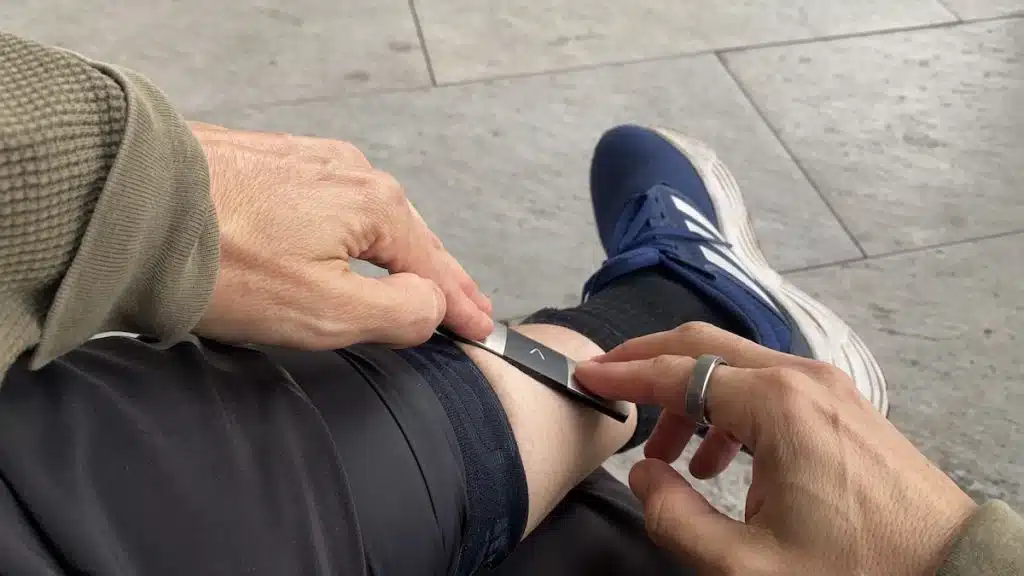
KardiaMobile 6L can do that as well, but it has a third electrode on the underside. Place that electrode against your bare left knee or ankle while keeping your fingers on the upper contacts and it records six leads rather than one.
That is the big dividing line here. The 6L captures leads I, II, III, aVR, aVL and aVF, giving someone looking at the ECG six different electrical views of the heart rather than one.

That does not mean the Kardia app suddenly becomes six times better at telling you what is happening. As I found during my KardiaMobile 6L review, the additional information becomes useful when the ECG itself is being examined by someone who knows how to interpret it.

So if all you want is an occasional 30-second check for AFib or another supported rhythm classification, the standard KardiaMobile can already do that job. If you expect to save ECGs and show them to a cardiologist, the argument for the 6L becomes much stronger.
KardiaMobile Card wins easily on portability
The Card remains my favourite of the three purely from a design perspective. It really is about the same size and thickness as a credit card, and at just 7.4 grams there is almost nothing to it.
When I reviewed the KardiaMobile Card, that was the feature that stood out most. You can put it in a wallet and pretty much forget it is there until you need it, which is not something you can say about many health gadgets.

Using it is simple as well. There are two electrodes on the front, you rest your fingers or thumbs on them, and the Card sends the recording to the Kardia app over Bluetooth. There is no charging cable to keep track of, and the built-in battery is designed to last around two years.
The trade-off is that the battery is not replaceable. The standard KardiaMobile and 6L both use replaceable CR2016 coin cells, so they are potentially the better long-term proposition if you plan to keep the same hardware for years.
The ordinary KardiaMobile is also very portable. It weighs just 18 grams and is only 3.5mm thick, so the Card is not solving a huge size problem here. It simply takes the concept to its logical conclusion by making the ECG monitor something you can leave in your wallet permanently.
Interestingly, the standard KardiaMobile also uses a different method to communicate with your phone. Instead of Bluetooth, it transmits the ECG signal using ultrasonic audio that your phone’s microphone picks up. There is no Bluetooth pairing involved, although it does mean microphone access and positioning the device reasonably close to the phone are important when taking a reading.
The 6L is slightly less convenient but much more capable
Having used the KardiaMobile 6L for several weeks, I did not find the extra electrode particularly troublesome. Single-lead readings are as straightforward as they are on the other devices, while switching to six leads only adds the step of placing the underside of the device against your left knee or ankle.
It can feel a little fiddly the first few times. I also managed to hold the unit upside down occasionally during testing, which is an easy mistake because the device is basically a small black rectangle with electrodes on it.
But this is hardly a major inconvenience. The whole process still takes around half a minute, and I would happily accept the slightly more awkward position in exchange for the extra ECG information if I had a reason to collect it.
That is also why I think the 6L makes more sense than simply buying a single-lead device because it is cheaper. If you are buying a dedicated ECG monitor rather than relying on the ECG already built into an Apple Watch or another smartwatch, there is a reasonable argument for getting something that goes beyond what your watch can already record.
The 6L still remains tiny. At 24 grams, it weighs almost nothing, requires no charging and easily disappears into a pocket or bag. It is less elegant than carrying the Card in your wallet, but we are talking about different degrees of very portable here.
The Kardia app is largely the same experience
Whichever device you choose, you end up spending most of your time in the Kardia app rather than interacting with the hardware. That means the differences between the three devices become much smaller once a recording has finished.
The app stores your ECG history, shows your heart rate and gives supported rhythm classifications. You can also add notes and export ECG recordings as PDFs, which is particularly useful if you want to send them to a doctor.
I liked that part of the experience when testing the 6L. You do not need a KardiaCare subscription just to make six-lead recordings and export them, which means the main reason for buying the hardware does not sit behind another recurring payment.
Where things become less appealing is AliveCor’s premium software layer. KardiaCare unlocks additional rhythm classifications and other analysis and reporting features, but I found the app a little too keen to push the subscription when I reviewed the 6L.
I would not choose between these three devices based on KardiaCare. The core distinction remains the hardware, and all three can perform their basic ECG functions without requiring an ongoing subscription.
Which KardiaMobile should you buy?
For most people who simply want the cheapest way into AliveCor’s ecosystem, KardiaMobile is probably enough. It provides the basic single-lead ECG functionality, costs less than the other two and uses the same Kardia app.
KardiaMobile Card is the more interesting option for someone who wants to keep an ECG monitor with them all the time. Having used it myself, the credit-card format is not a gimmick. It genuinely makes the device easier to carry because you do not have to remember to bring it.
KardiaMobile 6L is the one I would choose if the ECG data itself is the priority. It is still extremely portable, but the ability to record six leads gives it a clear functional advantage over both single-lead alternatives.
There is no need to buy the 6L simply because it sits higher in the range. If all you want is the occasional single-lead recording, KardiaMobile gets you there with less money spent, while the Card provides essentially the same ECG concept in a cleverer package.
View on AliveCor’s website, Amazon.
Don’t miss the latest from Gadgets & Wearables
Subscribe to our monthly newsletter and check out our YouTube channel.
You can also follow Gadgets & Wearables on Google News and add us as a preferred source in Google Search.

