

Garmin, Apple and Oura lead very different accuracy tests
We’ve ranked 13 major wearable brands across 12 different accuracy metrics, and the result is pretty clear: there is no single brand that is best at everything. Garmin dominates several sports-focused measurements, Oura is strongest around sleep and recovery, Apple looks like a great all-rounder, while Fitbit and Samsung each have several areas where they rank near the top.
We’ve been building out our Wearable Accuracy database metric by metric, using validation studies and primary-source evidence. Our rankings will be updated monthly, and they currently tap into 158 third-party research studies, systematic reviews, meta-analyses, FDA records and some manufacturer validation documents.
Garmin and Oura are good at very different things
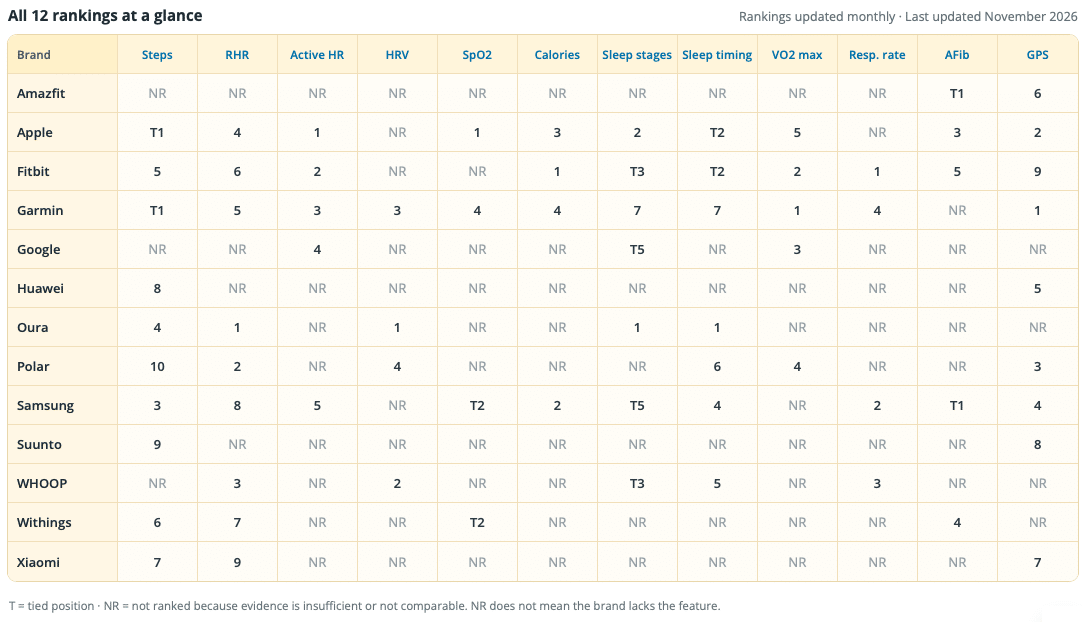
Garmin probably has the clearest sports-focused profile. It shares first place for steps, ranks third for active heart rate and HRV, and takes first place for both VO2 max accuracy and GPS accuracy. It also has a numerical position in 11 of the 12 categories, which gives it the broadest ranked coverage in the current table.
Sleep is where the Garmin picture changes. It sits well behind the leaders for both sleep stages and sleep timing. That is a useful reminder that a watch can be excellent at measuring your run without necessarily being the most accurate device to wear to bed.
Oura almost flips that around. It ranks first for resting heart rate, HRV, sleep-stage accuracy and sleep timing. It also comes fourth for steps.
Apple may have the most balanced profile
Apple is probably the hardest brand to pigeonhole. It shares first place for step counting, takes first for active heart rate and SpO2, ranks second for sleep stages and GPS, and shares second place for sleep timing.
There are weaker areas. Apple is fifth for VO2 max and third for calorie estimates, while its native HRV output is not directly comparable enough with the overnight RMSSD evidence used for our HRV leaderboard. Even so, Apple has ranked evidence across 10 of the 12 categories, and several of those positions are near the top.
Fitbit also comes out surprisingly well when everything is viewed together. It ranks first for calorie expenditure and respiratory rate, second for active heart rate and VO2 max, and shares second place for sleep timing. Its step-count ranking is fifth and GPS is ninth, so the picture is far from uniformly strong.
Samsung is similarly broad. It ranks third for steps, second for calorie expenditure and respiratory rate, shares second for SpO2, and shares the top AFib tier with Amazfit in our AFib detection ranking. Samsung also sits fourth for GPS, although resting and active heart rate currently place lower.
There really isn’t one most accurate wearable
So what does this tell us? Probably the biggest takeaway from putting all 12 rankings into one table is that there is no single winner. Asking which wearable is “most accurate” without saying what you want it to measure does not really work.
For running and outdoor tracking, Garmin makes an extremely strong case. For sleep and overnight recovery metrics, Oura looks better. Apple covers a wide range of measurements without many obvious weak spots, while Fitbit and Samsung each lead or challenge for several individual metrics.
There is another important detail in the table. An “NR” does not mean that a device lacks a feature or that the feature is inaccurate. It means there are not enough third party studies on a metric to give the brand a defensible numerical position.
The full table is live in the Wearable Accuracy section.
Don’t miss the latest from Gadgets & Wearables
Subscribe to our monthly newsletter and check out our YouTube channel.
You can also follow Gadgets & Wearables on Google News and add us as a preferred source in Google Search.

