

Oura files detailed blood pressure patent as research study continues
Oura has been running a Blood Pressure Profile Study inside Oura Labs, focused on spotting hidden hypertension risk using data from the ring. A newly granted US patent now shows what the company is building behind the scenes, and it goes much further than the careful language used in that study.
The patent, published earlier today, spells out a much more detailed approach to cuffless blood pressure. It explains how Oura could estimate blood pressure using pulse timing data from the ring, and in some cases from other devices too. In doing so, it fills in a lot of the technical detail that the public-facing study skates around.
What the patent describes
At its core, the patent focuses on measuring how long it takes a pulse wave to travel between two points on the body. This timing difference, often referred to as pulse transit time or pulse arrival time, is then used to estimate blood pressure.

The interesting part is how Oura proposes to do this in practice. The patent does not rely on a single sensor reading in isolation. Instead, it combines optical signals from the ring with data from other sources, such as a phone camera, additional wearable sensors, or even different sensing locations on the same device.
Diagrams in the patent show multiple signal types aligned in time, including optical pulse data and electrical or mechanical heart signals. The system synchronises internal clocks, accounts for sensor distance, and adjusts for sampling delays. This level of detail suggests Oura is tackling the hard engineering problems that make cuffless blood pressure so difficult.
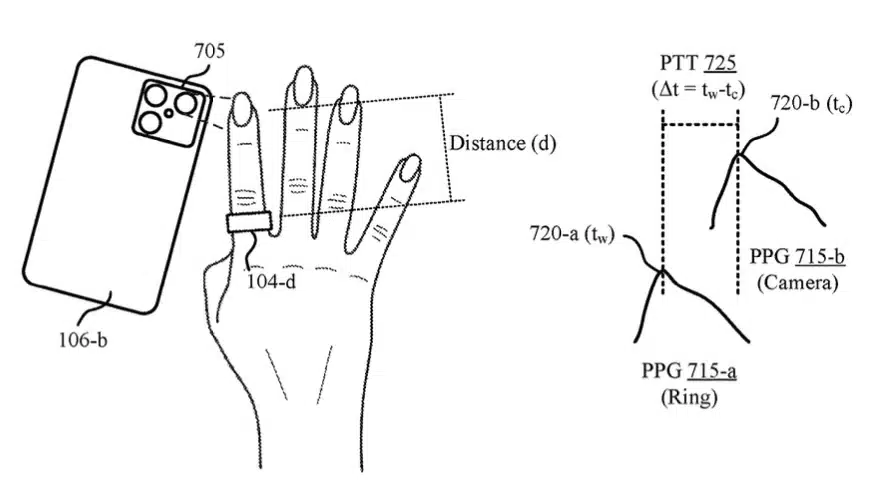
The patent also describes continuous calibration. Rather than a one-time setup, the system recalibrates based on changes in signal quality, user physiology and device positioning. This is paired with machine learning models that translate pulse timing data into blood pressure estimates.
How this goes beyond the current Oura Labs study
The December Blood Pressure Profile Study is framed as research. It talks about identifying potential hypertension risk and contributing data to science. It avoids promising blood pressure readings and it stays firmly in the territory of trends and insights.
The patent tells a different story.
First, it explicitly describes determining blood pressure metrics, not just risk. User interface examples in the patent include systolic and diastolic values, trend graphs, along with prompts related to calibration and timing.
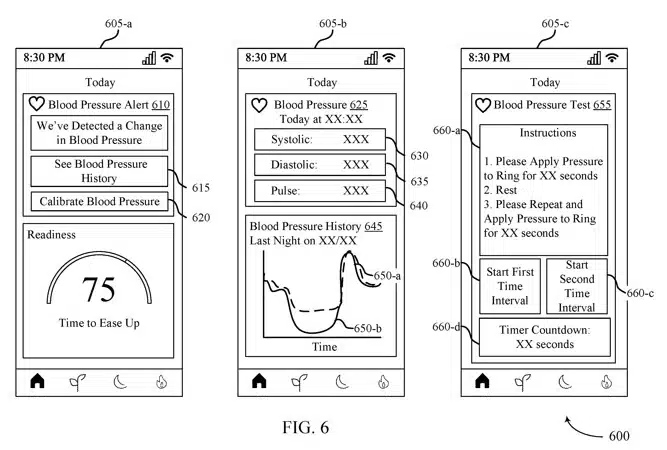
Second, the hardware scope is broader. The study implies a ring-only experience. The patent repeatedly references multi-device setups, including ring plus phone camera combinations. That suggests Oura is not limiting blood pressure estimation to what fits inside the ring today.
Third, timing precision is treated as the main innovation. The public study mentions translating signals into insights. The patent focuses on clock alignment, pulse detection windows, and compensating for signal delay. This is the unglamorous work that makes or breaks cuffless blood pressure.
Finally, the patent reads like a product blueprint. There are defined components, data flows, and user-facing screens. That is very different from the cautious tone of a limited research programme.
Why Oura is being careful in public
Blood pressure is a bit of a nightmare when it comes to regulation. Even the big smartwatch players have been tripping over it for years, stuck in that awkward space between “wellness” and something doctors would actually sign off on. Oura’s careful tone around this stuff fits right into that reality.
Calling the current work a study gives Oura breathing room. It can pull in real world data, fine tune its models, and see how people respond to heart health insights, all without making promises it cannot legally back up yet. The patent makes it clear this is a deliberate slow burn, not a lack of confidence.
This also does not mean you should expect blood pressure numbers to suddenly pop up in the Oura app. Patents are about where a company wants to go, not when it will get there. What it does tell us is that Oura is taking cuffless blood pressure seriously and is willing to invest in it for the long haul.
This article originally appeared on Gadgets & Wearables, the first media outlet to report the story.
Source: US Patent Office
Subscribe to our monthly newsletter! Check out our YouTube channel.
And of course, you can follow Gadgets & Wearables on Google News and add us as a preferred source to get our expert news, reviews, and opinion in your feeds.
