

Unitree’s 10.1 metres per second robot run sparks Usain Bolt comparisons
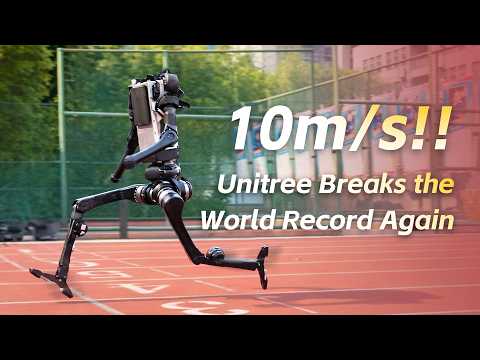
Unitree’s humanoid H1 has posted a peak speed of 10.1 metres per second during a 100 metre track run, a figure that instantly grabbed attention because it brushes up against elite human sprint territory. Before anyone starts polishing a replacement plaque for Usain Bolt, it is worth noting that this was the robot’s top speed, not its full 100 metre time.
The video itself is undeniably fun to watch. There is something slightly surreal, and admittedly a bit funny, about seeing a humanoid robot charging down a running track like it has somewhere very important to be. It feels less like watching a smooth Olympic sprinter and more like seeing a determined machine late for its own firmware update.
Fast, but not world record fast
What’s worth noting here is that the robot has hit 10.1 meters per second at one point. Which is not the same as averaging that speed from start to finish. Bolt’s 9.58 second world record works out to an average speed of 10.44 metres per second across the full 100 metres, despite starting from a standstill.
That is the part that often gets lost when these clips start doing the rounds on social media. Peak speed is the headline number. But average speed is what the stopwatch cares about. A car touching 200 km/h for a second on a straight is not the same as averaging that across an entire lap, and the same logic applies here.
The H1 is clearly quick, and much quicker than most people would expect from a full-sized humanoid (minus the head). But it needs further improvements before it can genuinely be mentioned in the same breath as elite sprinting performance.
The movement still looks very robotic
There is also the small matter of how it moves. The H1’s stride looks fast, but not exactly graceful. It is more rapid mechanical stepping than fluid sprint mechanics. In fairness, that is part of what makes the clip so compelling.
Human sprinters make running at that speed look almost effortless, even though it is anything but. The robot, by contrast, looks like it is working extremely hard for every metre. There is a slight drift in its line too, which adds to the sense that this is still very much an engineering demo rather than something ready for lane four at the Olympics.
That said, it is still a serious technical achievement. Keeping a humanoid stable at these speeds is no small task. Balance, foot placement, traction, and real-time correction all need to work together, and one bad step could easily send it face-first onto the track.
Bolt can still sleep easy – for now…
So, is Bolt’s record under threat? Not yet. The robot would need faster acceleration, better directional control and, most importantly, the ability to sustain a much higher average pace over the full distance.
Still, this is the sort of thing that makes for great headlines and even better videos. For now, the record books remain safe, but it is not every day a robot gives sprint fans a reason to check the numbers twice.
Subscribe to our monthly newsletter! Check out our YouTube channel.
And of course, you can follow Gadgets & Wearables on Google News and add us as a preferred source to get our expert news, reviews, and opinion in your feeds.
