

RingConn tracked my headache without input and got the timing right
I had a headache a few days ago, and to my surprise, RingConn knew about it before I even thought to mention it. This is the only wearable I’m aware of that actively flags up headache events, and the fact that it can do this from something sitting on your finger is what makes it even more impressive!
Headache detection that actually works
The feature is part of the Health Alerts section added in version 3.13.0 of the RingConn app. It includes a tool called Headache Signs, which attempts to detect headache episodes based on biometrics like heart rate variability and skin temperature, along with local barometric pressure changes. When a pattern emerges that fits a known profile, the app opens a tracking window.
At launch, I didn’t pay much attention to the feature. Wearable brands sometimes introduce health tools that sound promising but turn out to be gimmicky or inconsistent in real-world use. This felt like it might fall into that category.
Then, on December 14, the app began tracking what it classified as a potential headache event. It ended the tracking at 10:52 on December 15. That time window lined up almost perfectly with how I felt.
I didn’t log anything, I didn’t take any action to prompt the app. It just flagged it. And it only did so once during the entire three-week period. I actually don’t remember the last time I had a headache, which made the accuracy of this detection even more surprising. It was one of those headaches that comes in waves.
The app didn’t claim certainty or issue a diagnosis. It monitored changes and gave a nudge when it looked like something was off.
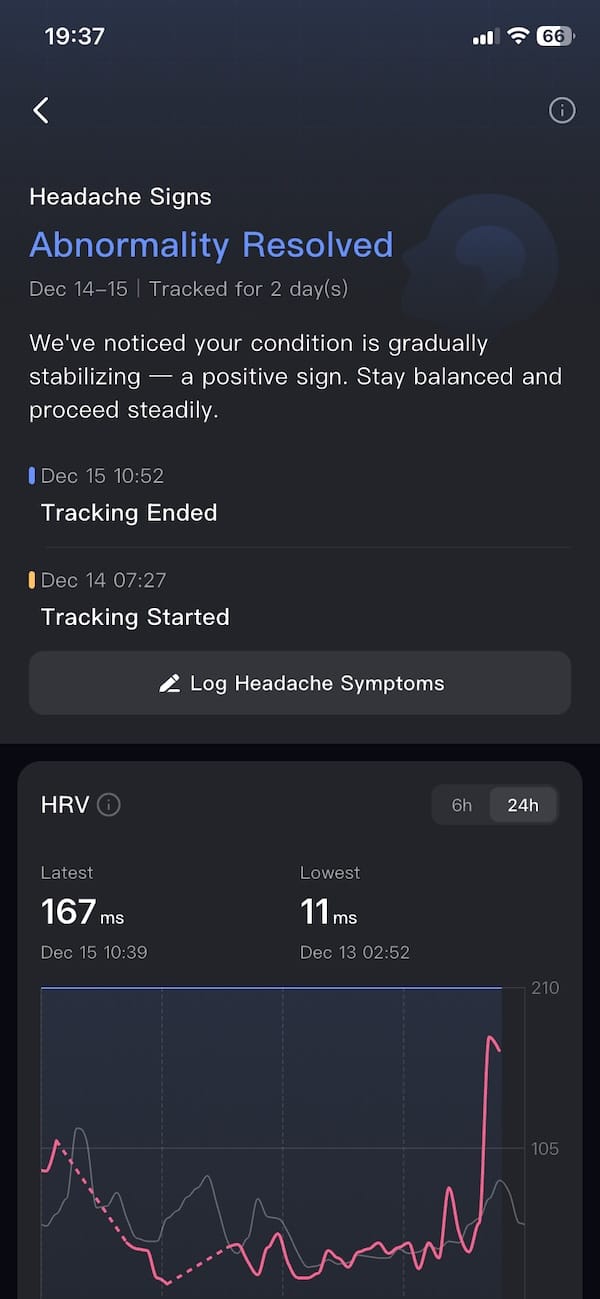
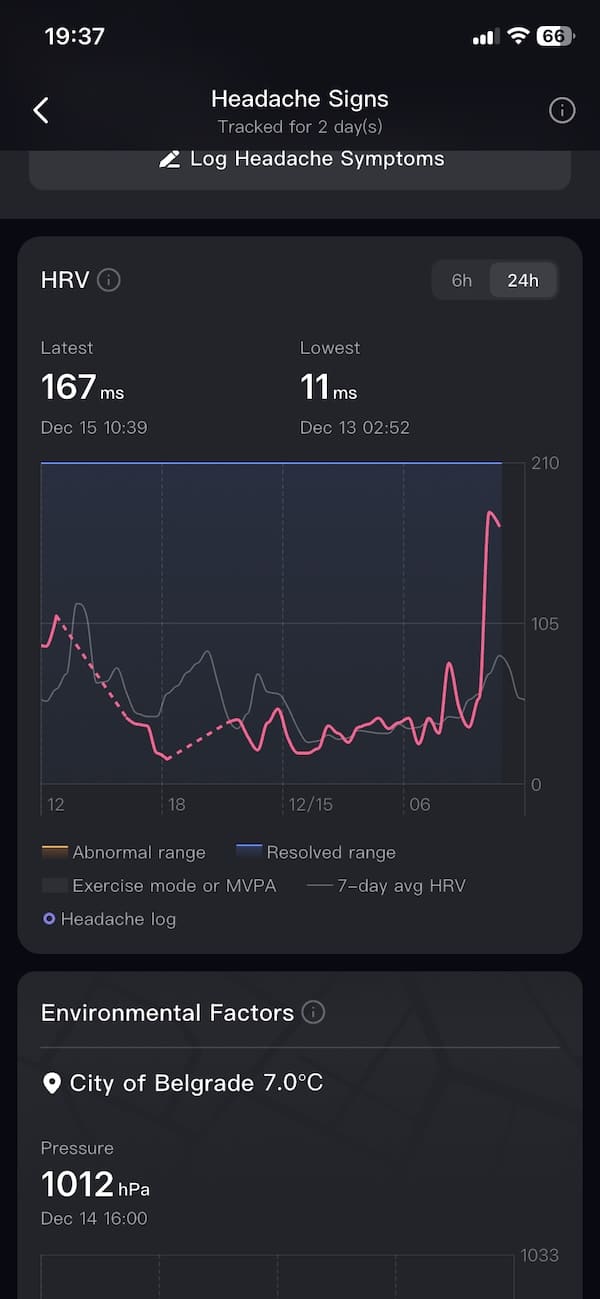

Looking at the HRV trends
Looking at the data, my HRV did dip significantly the day before, but whether that reading played any role is unclear. It might have been an outlier. The more notable shift came during the episode itself, with HRV steadily increasing toward the end of the flagged period. This supports the idea that RingConn’s system evaluates trends rather than reacting to isolated drops.
This kind of logic suggests a time-based approach. The ring does not appear to rely on any one signal. It looks at sustained changes and correlations between multiple metrics. The return to a normal range may be part of what closes the alert.
Environmental data closes the loop
The ring doesn’t just track your biometrics. It also taps into local environmental pressure data. Around the time of the event, pressure was logged at around 1012 hPa. That’s not extreme, but a change might have contributed.
This approach of combining internal and environmental signals creates more opportunities for targeted alerts. In theory, this reduces false positives and improves timing.
This feels like a first in wearables
To my knowledge, no other wearable currently offers this kind of passive headache detection. Some platforms track symptoms when you log them manually, but RingConn is taking a different approach. It flags events based on observed data, without requiring user interaction.
I had not paid much attention to this feature when it launched. But after seeing it work in a real-world situation, it stands out. It picked up on a single event, matched the duration accurately, and then stayed silent afterward. For a ring that sits quietly on the finger, that is a notable capability.
Next time I get a headache, I’ll definitely be checking the RingConn app again. If it picks it up a second time, I’ll be doubly impressed.
You can also read my hands-on review of the device. With holiday discounts currently available, it may be a good moment to consider picking one up if it’s been on your radar.
Subscribe to our monthly newsletter! Check out our YouTube channel.
And of course, you can follow Gadgets & Wearables on Google News and add us as your preferred source to get our expert news, reviews, and opinion in your feeds.
