

Amazfit T-Rex Ultra 2 vs the T-Rex 3 Pro: What’s actually different
The Amazfit T-Rex Ultra 2 landed yesterday and it is very clearly the biggest and toughest watch Amazfit has made so far. It is a large chunk of metal with a grade 5 titanium back, a battery designed to last for weeks and a lot more onboard storage mainly aimed at offline maps.
Since we reviewed the T-Rex 3 Pro not long ago, this comparison is really about how far the Ultra 2 actually moves the needle. The sensors and core experience are largely the same, so the real differences come down to size, battery life and navigation. If you already know the 3 Pro well, the Ultra 2 reads like a more extreme version of the same idea rather than a totally new direction.
View on Zepp Health, Amazon.
Jump to
A significant jump in physical presence
One of the first things you notice about the T-Rex Ultra 2 is its sheer size. It comes in a 51mm case which makes it the largest watch in the current lineup. This is a step up from the 48mm size found on the T-Rex 3 Pro. If you have smaller wrists you might find the 44mm version of the 3 Pro more comfortable but the Ultra 2 only comes in this one massive footprint.


The materials used in the build have also seen an update. While both watches use titanium for the bezel and buttons the Ultra 2 adds a grade 5 titanium back panel. This makes the watch feel very solid and high quality compared to the polymer back on the 3 Pro. However you should be aware that this extra metal brings the weight up to 89.2 grams which is nearly double what the 48mm 3 Pro weighs.
Massive battery capacity and storage
Under the hood the T-Rex Ultra 2 features a 870 mAh battery. This is a large increase over the 700 mAh cell in the T-Rex 3 Pro. Zepp Health says this will give you up to 30 days of use in typical mode or over 50 hours of high accuracy GPS tracking. In comparison the 3 Pro offers 25 days of typical use and 38 hours of GPS which is still good. So we do get an increase with Ultra 2 but probably not something that will influence a buying decision too much.
Storage may matter, though. It has doubled from 32GB on the 3 Pro to 64GB on the Ultra 2. This extra space is mostly there to handle the new mapping features. You can now store much larger areas of topographic data and base maps directly on the watch without having to swap files in and out through the phone app as often.
New navigation tools and offline planning
The navigation software on the Ultra 2 is a bit more capable than what we saw on the 3 Pro. It can now handle offline route planning for distances up to 100 kilometers. This means you can pick a destination on the watch screen while you are completely offline and it will calculate a turn by turn path for you. The 3 Pro can do some basic routing but it is not optimized for these long distances without a phone connection.

You also get better elevation data and climb segmentation on the newer model. It displays your progress on steep sections more clearly and includes checkpoint reminders. These markers allow you to set specific points for water or rest stops which appear on your route timeline. While the 3 Pro is very capable for general hiking these extra tools on the Ultra 2 make it feel more like a dedicated tool for complex expeditions.
Unique lighting and display tech
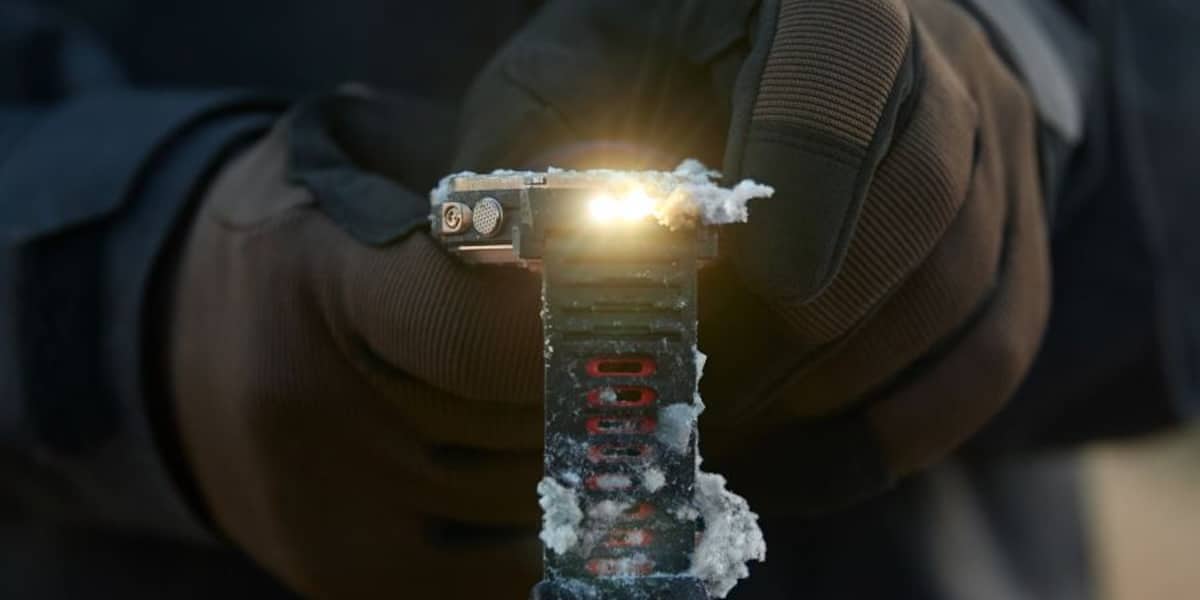
Then we get to the flashlight. Anyone who has used the feature on a smartwatch knows how useful it is.
The good news is that both of these watches have built in LEDs. But the Ultra 2 uses a green light as its secondary option while the 3 Pro uses red. Green light is easier for the human eye to see at low brightness and helps with contrast when looking at terrain. It also works better if you happen to be using night vision equipment.

The display on the duo is a 1.5 inch AMOLED (for the 48mm version of T-Rex 3 Pro), but the Ultra 2 seems to handle map rendering a bit more smoothly. Both panels reach 3000 nits of peak brightness so visibility in direct sun is not an issue for either device. Using sapphire glass on both models ensures they can take a hit without scratching easily during outdoor use.
Worth an upgrade? Probably not.
Honestly, the difference between these two is not that dramatic. It really comes down to three things, battery life, storage and the titanium back.
The Ultra 2 sits at around 550 dollars, which is roughly 150 dollars more than the T-Rex 3 Pro’s price tag (check price on Zepp Health, Amazon). And what you are mostly paying for is more room for maps and stuff you want to keep on the watch, plus a battery that lasts longer. If you already have the 3 Pro, there is not a strong reason to upgrade unless you constantly hit storage limits or hate worrying about charging on longer trips.
The Ultra 2 does feel tougher and more serious, especially if you load it up with big offline maps and use it properly for navigation. That extra storage really matters there. But for most people, the T-Rex 3 Pro still does the job just fine at its lower price. It tracks the same things, feels similar day to day and costs a lot less, which makes the Ultra 2 feel more like an optional step up rather than something you really need.
Tech specs comparison
Specification | Amazfit T-Rex Ultra 2 | Amazfit T-Rex 3 Pro |
|---|---|---|
Case size | 51 mm | 48 mm (also sold in 44 mm) |
Case build | Grade 5 Titanium bezel, buttons, and back panel with polymer frame | Grade 5 Titanium bezel and buttons with polymer frame and back |
Weight | 89.2 g | 49 g (48 mm version) |
Display | 1.5 inch AMOLED | 1.5 inch AMOLED (48 mm) and 1.32 inch AMOLED (44 mm) |
Resolution | 480 × 480 | 480 × 480 (48 mm) |
Pixel density | 322 ppi | 322 ppi (48 mm) |
Peak brightness | Up to 3000 nits | Up to 3000 nits |
Glass | Sapphire | Sapphire |
Battery capacity | 870 mAh | 700 mAh (48 mm) |
Claimed battery life | Up to 30 days | Up to 25 days (48 mm) and up to 17 days (44 mm) |
GNSS | Dual band GNSS | Dual band GNSS |
Maps preloaded | Global base map (terrain) only | Maps are installed via the app |
On device route planning | Advanced 100km offline route planning and global maps | Standard route planning and POI search |
Internal storage | 64 GB total | 32 GB |
LED Flashlight | Dual-color (White and Green) | Dual-color (White and Red) |
Main biometric sensor | BioTracker 6.0 PPG | BioTracker 6.0 PPG |
Price | $550 | $400 |
Don’t miss the latest from Gadgets & Wearables
Subscribe to our monthly newsletter and check out our YouTube channel.
You can also follow Gadgets & Wearables on Google News and add us as a preferred source in Google Search.

