

Samsung’s next Galaxy Watch is getting Qualcomm’s new 3nm chip
At MWC 2026, Samsung confirmed something a lot of Galaxy Watch watchers did not see coming. The next Galaxy Watch will run on Qualcomm’s Snapdragon Wear Elite, a 3nm chip, and it will be the first time Samsung has put Snapdragon silicon into its main Galaxy Watch line. The news was confirmed by InKang Song, Samsung’s EVP and Head of Technology Strategy.
What Is the Snapdragon Wear Elite?
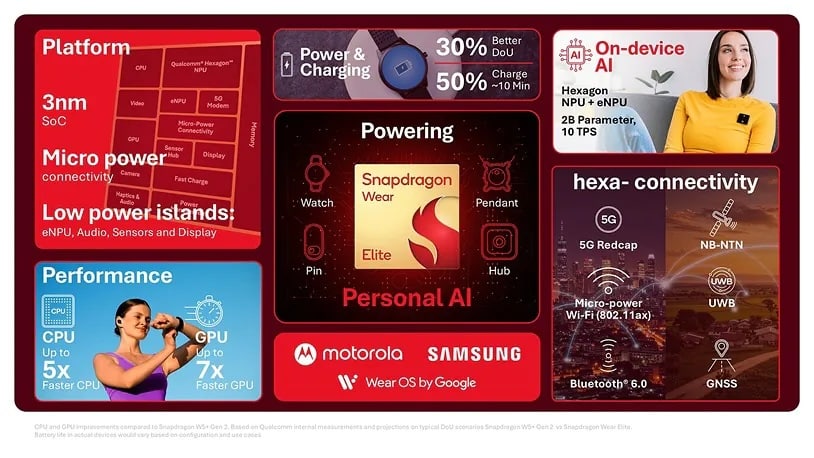
The Snapdragon Wear Elite is Qualcomm’s latest wearable chip, built on a 3nm process and designed specifically for Wear OS devices. It sits above the older Snapdragon W5+ Gen 2, and on paper the gap is significant.
Qualcomm claims up to 5x faster CPU performance and up to 7x faster GPU performance compared to that predecessor. CPU clock speeds reach up to 2.1 GHz, with a core layout of one performance core and four efficiency cores.
Memory and storage get a proper upgrade too. The chip supports LPDDR5 memory running at up to 6,400 MHz, and up to 32GB of eMMC storage. All of this is a very solid foundation for a modern smartwatch.
The AI story
It’s all seems to be about Ai these days. And the story is no different here.
Qualcomm is leaning into on-device AI harder than it has on any previous wearable chip. The Snapdragon Wear Elite includes a dedicated Hexagon NPU alongside a secondary low-power eNPU, making this the first Snapdragon wearable chip to include a proper Hexagon NPU at all. It can handle models up to two billion parameters and delivers around 10 tokens per second.
In practice, that translates to things like smart replies, text summaries, AI fitness coaching, noise cancellation, along with activity and keyword recognition, all processed locally on the device. Whether any of that lands as genuinely useful features or just bullet points on a spec sheet will largely depend on what Samsung and Google do with the software side.
Battery and power
Battery life is where most people’s attention will naturally land. Qualcomm claims up to 30 percent improvement in days of use compared to the previous generation.
The chip achieves this partly through dedicated low-power islands that handle audio, sensors, display, and the eNPU independently, meaning background tasks can tick along without waking the main CPU. Fast charging is also supported, with 50 percent charge in around 10 minutes.
Thirty percent is a nice number on paper, but Galaxy Watch users have heard efficiency promises before. The Exynos W1000 in the Galaxy Watch 7 and Galaxy Watch Ultra is also a 3nm chip, and battery life on those devices has been decent but not class-leading. The real test will be whether Samsung’s software and battery capacity decisions let the Snapdragon Wear Elite’s efficiency gains actually show up in daily use.
The shift away from Exynos
For Samsung, this is a important move. The Exynos W1000 is its own in-house silicon, and it has powered the Galaxy Watch 7, Galaxy Watch 8, and Galaxy Watch Ultra. Switching to Qualcomm for the next generation suggests Samsung sees the Snapdragon Wear Elite as the better option right now, particularly given its AI hardware focus and power island design, two areas where the Exynos chip does not have direct equivalents.
It is worth noting that Qualcomm has positioned the Snapdragon Wear Elite for more than just watches. The platform is also intended for pins, pendants, and hubs, which points at a broader ecosystem ambition that Samsung may or may not tap into.
When and what exactly
Qualcomm says commercial devices are coming within the next few months. Samsung confirmed the chip is coming to the next Galaxy Watch, but has not specified whether that means the Galaxy Watch 9, a new Ultra model, or both. A staggered rollout across different models is entirely possible. For anyone currently weighing up whether to buy a Galaxy Watch 8 or Ultra, that ambiguity might be enough reason to wait a little longer and see what arrives.
Subscribe to our monthly newsletter! Check out our YouTube channel.
And of course, you can follow Gadgets & Wearables on Google News and add us as a preferred source to get our expert news, reviews, and opinion in your feeds.
