

WHOOP could be taking its next health step into glucose monitoring
A newly published WHOOP patent application describes a wrist-worn system that could estimate glucose concentration without puncturing the skin, using light, tuned optical filters and two separate sensors. The filing shows the hardware inside a WHOOP-style band, although it also covers patches, clothing, earbuds and several other wearable formats.
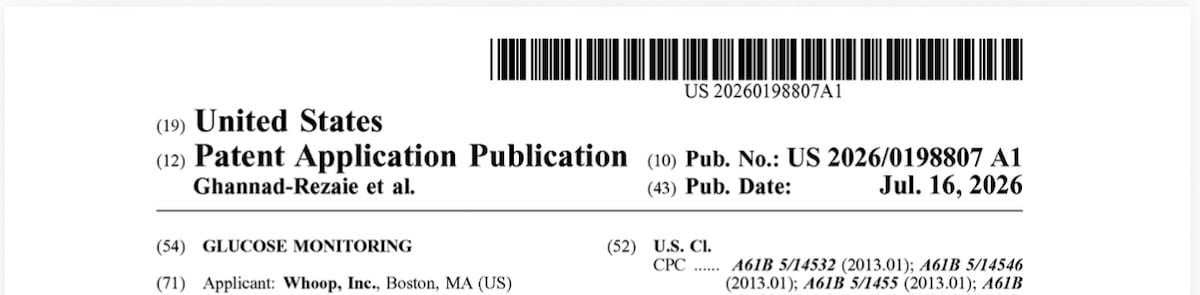
The patent application, titled Glucose Monitoring, was published on July 16 by the USPTO, under the number US 2026/0198807 A1. WHOOP filed it in January 2026, claiming priority from a provisional application submitted one year earlier.
How WHOOP’s glucose sensor would work
The proposed system shines selected wavelengths of light into the wearer’s tissue. Glucose absorbs some wavelengths differently from others, allowing the wearable to look for changes that may correspond to glucose concentration.
The filing describes WHOOP using two optical channels for this. One sensor measures wavelengths associated with glucose absorption, while a second records a reference spectrum. The software compares the two readings and calculates glucose concentration from the resulting ratio.

That reference measurement could help filter out some of the background noise that makes optical glucose sensing so difficult. Skin thickness, hydration, movement, temperature and other molecules can all change the amount of light reaching a sensor.
The application also describes using quantum dots or other tightly controlled light emitters. An optical layer containing glucose, or another material with similar absorption characteristics, could provide an additional reference signal inside the sensor itself.
The patent covers much more than a wristband
The main drawings show a screenless wrist-worn device that looks similar in looks with WHOOP’s existing approach. Sensors sit against the skin, while the wearable communicates with a phone and remote servers for further analysis. So no major changes there.
But the company has kept the broader claims flexible. The technology could appear in bicep bands, patches, fingertip devices, earbuds, eyewear, headbands and smart clothing with multiple removable sensor modules.
That breadth does not mean WHOOP plans to manufacture every one of those products. Patent applications commonly cover numerous configurations so that competitors cannot easily use the same sensing method in a slightly different form.

The patent does not show how this information would appear inside the WHOOP app. It also gives no indication that WHOOP 5.0 or WHOOP MG contains the necessary optical hardware, so this looks more like work for a future device than a dormant feature waiting to switch on.
Accuracy remains the real challenge
Wearable companies have pursued non-invasive glucose sensing for years, but turning a weak optical signal into reliable glucose readings remains difficult. Detecting a broad trend is one thing, while producing numbers that people can trust for medical decisions is something else entirely.
WHOOP’s reference channel and calibration methods appear designed to address part of that problem. However, the patent provides no clinical accuracy figures, error margins or testing results.
It is also unclear whether WHOOP wants to produce medical-grade glucose measurements or a broader wellness feature that tracks relative changes. The second option could arrive sooner, particularly if the company avoids presenting the readings as a replacement for a conventional glucose monitor.
For now, this remains a patent rather than a product announcement. Still, most of the WHOOP patents we have covered in the past have eventually translated into real-world products or features, so this one is worth taking seriously.
What is clear is that the company is looking beyond the measurements it offers today. Another recent patent describes a sensor that could be worn on different parts of the body, with muscle oxygen tracking among the more interesting ideas. Add glucose monitoring to the mix and it seems WHOOP is exploring a much wider set of health signals
This article originally appeared on Gadgets & Wearables, the first media outlet to report the story.
Source: USPTO patent application
Don’t miss the latest from Gadgets & Wearables
Subscribe to our monthly newsletter and check out our YouTube channel.
You can also follow Gadgets & Wearables on Google News and add us as a preferred source in Google Search.

