

Garmin launches Forerunner 70 as its new entry running watch
Garmin has launched the Forerunner 70, a new entry-level running watch with a 1.2-inch AMOLED display, built-in GPS and up to 13 days of battery life. It arrives alongside the more feature-packed Forerunner 170, but this cheaper model may be the more interesting one because Garmin has pushed a lot of its newer training tools much further down the range.
The watch starts at $249.99 and goes on sale from May 15 on the company’s website. On paper, it replaces the Forerunner 55 as Garmin’s starter running watch, but the jump is big enough that this feels like a different category of product.
This is not just a basic Forerunner anymore
The Forerunner 55 was a useful running watch, but it came from a different Garmin era. It had a 1-inch MIP display, button-only controls and Garmin’s older Elevate Gen 3 heart rate sensor.
The Forerunner 70 moves to a 1.2-inch AMOLED display, adds touchscreen controls and upgrades the heart rate sensor to Elevate Gen 4. Garmin has also kept the five-button layout, which is still a sensible choice for running because sweaty fingers and touchscreens do not always get along.
That combination changes the feel of the watch straight away. It is still Garmin’s lower-cost Forerunner, but it no longer looks like a leftover from the older budget GPS watch playbook.
Garmin has also brought over more of its current interface. That includes widget glances, a newer sports UI, watch focus modes, larger font options, shortcuts, an on-device Connect IQ Store, a calculator, a battery usage widget and other small daily-use tools.

Training features move down the range
The bigger story is the training feature set. Garmin says the Forerunner 70 includes Training Readiness, Training Status, wrist-based running power and running dynamics.
That is a serious upgrade for this part of the range. Training Readiness uses recent activity, sleep, stress, HRV and recovery data to give users a clearer idea of whether they should train hard or take things easier.
Training Status looks more at the longer training picture. It uses recent load, fitness trends and related metrics to show whether training is productive, maintaining, strained or heading in the wrong direction.
Garmin has also added Acute Load, Load Focus, Load Ratio, Recovery Time and VO2 Max trending. For a watch aimed at new and aspiring runners, that is a lot of training context.
The interesting bit is not just that Garmin has added more charts. It has given beginners access to the same language of training and recovery that Garmin uses higher up the range.

Quick Workouts could be the most useful new feature
Quick Workouts may end up being one of the more useful additions. Instead of forcing users to build a structured session from scratch, the watch can generate workout options based on a desired duration and intensity.
That is a smart fit for the target buyer. Plenty of runners do not want to plan every interval session in Garmin Connect the night before. They want to head out, choose how long they have and get a session that makes sense.
Garmin Coach also gets broader support. The company says Run Coach now includes run/walk workouts and lower-volume plans, which should make the system more approachable for beginners or people returning after time away from training.
Daily suggested workouts are also part of the package. These adapt after each run based on recent performance and recovery, so the watch has a better chance of staying useful after the first few weeks of novelty wear off.
This is where the Forerunner 70 starts to make more sense. Garmin is not only selling GPS, pace and heart rate. It is selling a watch that can nudge someone into more consistent training without making the process feel too technical.
The sports list is much wider now
Garmin has also expanded the activity profile list quite aggressively. The Forerunner 70 includes more than 80 built-in sports apps, covering running, cycling, swimming, strength training, hiking, racket sports, winter sports, team sports and more.
That makes it a broader fitness watch than the old entry-level Forerunner idea suggests. It can track road cycling, mountain biking, gravel biking, pool swimming, strength training, jump rope, yoga, Pilates, hiking, rucking, boxing, mixed martial arts and a long list of outdoor and team sports.
It also supports external sensors such as heart rate straps, footpods, cycling speed and cadence sensors, cycling radar, cycling lights, RD Pod and Tempe. That gives it more room to grow with a user, especially if they start running first and then add cycling or structured workouts later.
This does not turn it into a full multisport watch. But it does make the Forerunner 70 less narrow than older starter Forerunners, which is probably the right call in 2026.
Route tools are a nice surprise
Another interesting addition is route support. The Forerunner 70 does not have offline maps, and Garmin has kept that feature for more expensive watches.
But it does support course and route following, along with Up Ahead, aid station or rest break timers and time cutoff tools. Those are surprisingly advanced features for a watch at this level.
For road runners, breadcrumb route following will often be enough. Trail runners who depend on full mapping will still want to look higher up the range, but Garmin has clearly given the 70 more navigation depth than a basic running watch normally gets.
Battery life remains a strong point
The Forerunner 70 offers up to 13 days of battery life in smartwatch mode. Garmin also lists up to 5 days with the always-on display enabled.
For GPS use, the watch goes up to 23 hours in GPS-only GNSS mode and up to 16 hours in All-Systems GNSS mode. It does not have dual-frequency GNSS, but that is not surprising at this price.
What the Forerunner 70 still misses
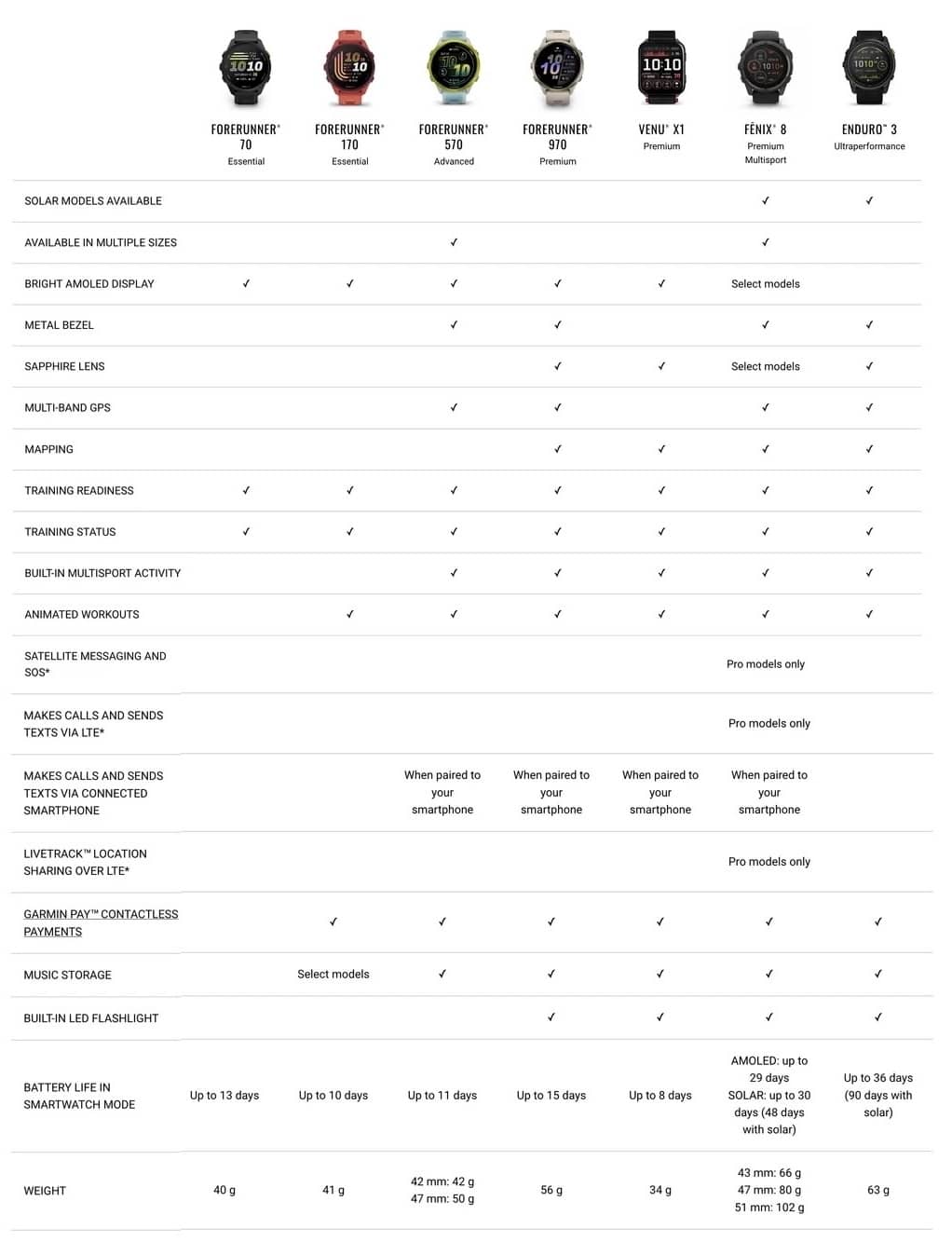
Garmin has left some clear distance between the Forerunner 70 and Forerunner 170. The 170 adds Garmin Pay, while the 170 Music adds phone-free music support from compatible third-party services.
The Forerunner 170 also gets an altimeter for floor climb, plus open-water swimming and guided meditation. The Forerunner 70 skips those, along with offline maps, triathlon and full multisport modes.
That split feels deliberate. Garmin has made the Forerunner 70 much more capable, but it has not made the Forerunner 170 pointless.
Initial thoughts
The Forerunner 70 looks like Garmin resetting expectations for its cheapest current Forerunner. It keeps the simple running-watch pitch, but adds the kind of display, training tools and software polish that make older budget models look dated.
At $249.99 on Garmin’s website, this is not a bargain-bin device. But it does look far more complete than Garmin’s old entry-level formula.
The most interesting part is how much Garmin has chosen not to hold back. Training Readiness, Training Status, running power, running dynamics, route following, Quick Workouts and a much larger sport profile list make this feel like a serious running watch for people who do not want to spend more.
The Forerunner 170 remains the better pick if you want Garmin Pay, music or a few extra sport features. But the Forerunner 70 may be the one that tells us more about Garmin’s direction. Entry-level no longer means basic, and that makes the new model a much stronger starting point for runners.
Don’t miss the latest from Gadgets & Wearables
Subscribe to our monthly newsletter and check out our YouTube channel.
You can also follow Gadgets & Wearables on Google News and add us as a preferred source in Google Search.

